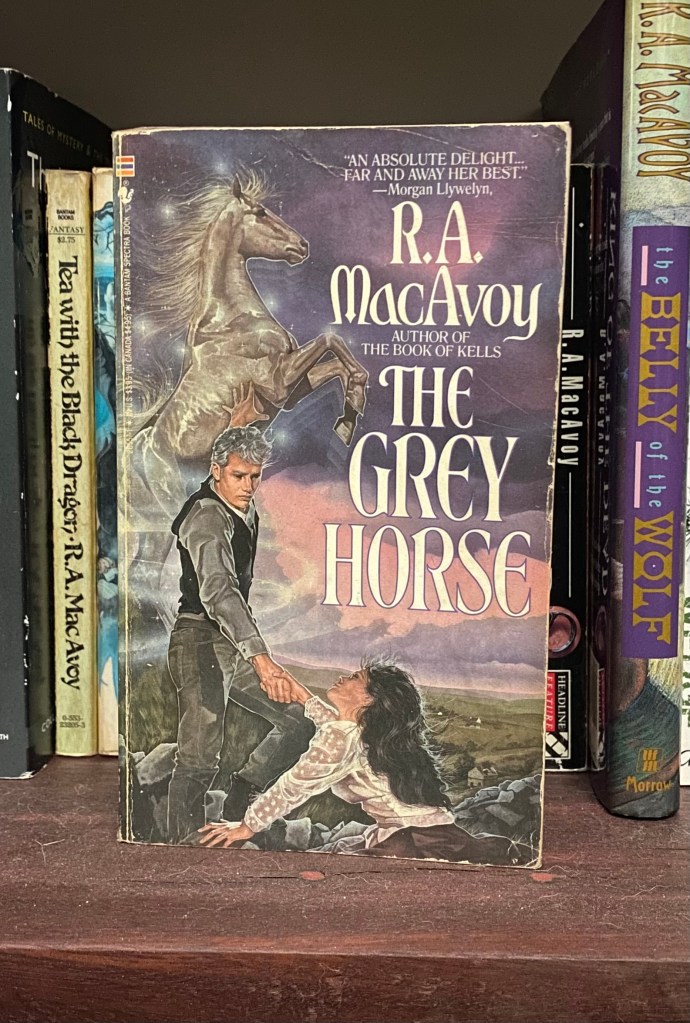
Anrai O Reachtaire, a horse trainer who lives in the small Irish town of Carraroe, finds a stray pony on the moors overlooking the town. He attempts to ride it home but what he doesn’t realise until too late is that the grey horse is Ruairi MacEibhir, one of the fairy folk – a puca, able to transform himself into the form of a horse. And he has come to Carraroe to find a wife…
R. A. MacAvoy burst onto the literary scene in 1983 with her debut novel, the award-winning Tea With The Black Dragon. She was fairly prolific in the years after that, producing the lovely Damiano trilogy, the time-travel fantasy The book Of Kells, and Twisting The Rope, the sequel to Tea With The Black Dragon. But this time we’re looking at her seventh novel, 1987’s The Grey Horse.
Like The Book Of Kells, it is set in Ireland. Unlike that frankly brilliant novel (it may yet cop a guernsey on this blog), it is completely historical, set in a small town that MacAvoy had to scour in order to find some history that she could tie to her new book. From the one little moment that she discovered (a group of local women protesting an eviction), she wove an entire novel, peopled with wonderful characters and settings.
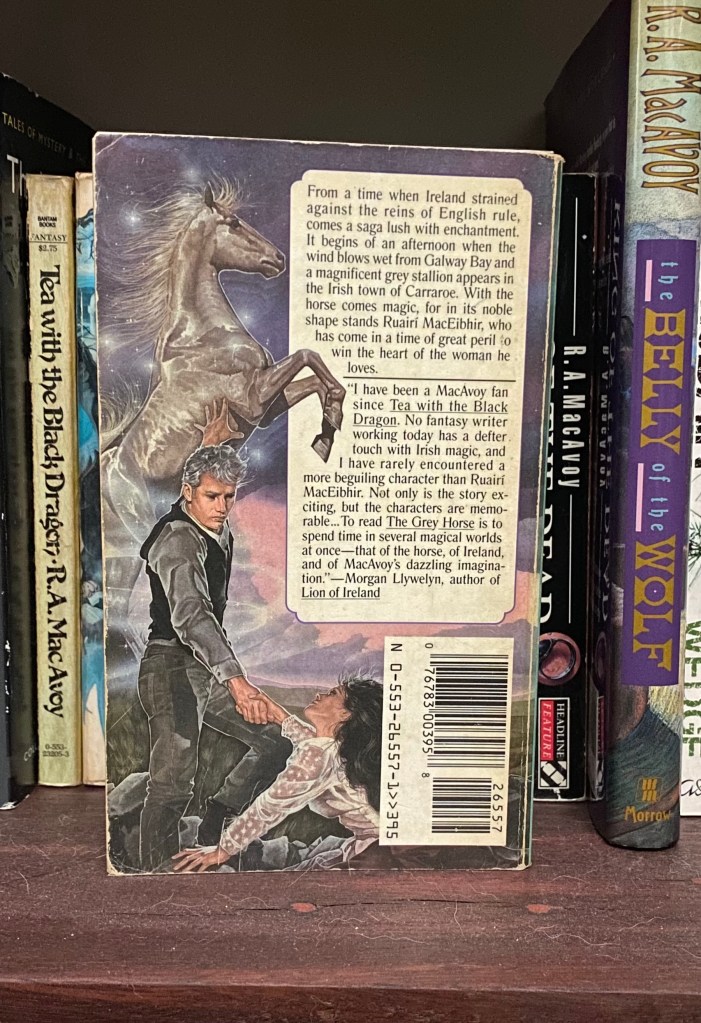
I have to say, though, that if it hadn’t been written by MacAvoy, I probably wouldn’t have read it. Charles DeMar’s cover is lovely, but it looks like it belongs on a romance novel, a genre that I was still turning my nose up at the worldly age of 17. But it was a MacAvoy book, so I knew that it would be special.
And it was. Every setting was painted beautifully on the page so that I was able to place myself instantly in the scene, whether it was Anrai’s barn or Squire Blondell’s house. I could feel the chill of the wind coming in from the North Atlantic every time Ruairi or another character was outside. But, like all of MacAvoy’s novels, I was there for the characters. And here we have an absolutely wonderful set of characters; Anrai and his wife Aine (Henry and Anne Raftery, according to the handy cast list at the front of the book) are an elderly couple who live off what they can earn from Anrai’s horse training; Squire Blondell and his family, estranged from the local community because of their Englishness but forced to live among them; Maire NiStandun (Mary Stanton), Ruairi’s intended, although (as in all the best love stories) not terribly keen on the idea at first; and Tadhg O Murchu (Tim Murphy) the local priest, who runs a little bit of insurrection on the side.
Those are our main players but there are others who play a smaller but no less important part in the proceedings, but none of whom are written as anything other than fully-developed characters in their own right.
I could go on all day about how wonderful these charcters are but I’ll just leave it with this quote from Anrai, who is pondering the mysterious stablehand he’s employed:
And little Toby, the young squire, who walked about telling folks that Ruairi had come off a horse and broken his eyes like egg yolks. Dear Lord, what a tale! Who in his right mind could believe that man would come off a horse?
It’s a wonderful glimpse into the mind of a character who is an expert in his own field but not in a lot of others. And it made me appreciate people like Anrai or Squire Blondell a little more. I wasn’t a particularly empathetic person when I was younger, but it was novels like this that made me appreciate that people could have their own worldviews that weren’t remarkably different to my own, despite presenting them in ways that I disagreed with.
The story unfolds at a nice pace, with a bunch of realistic twists and turns, including a few that will bring a lump to your throat. None of them would be out place in a non-fantasy novel, I stress to add. MacAvoy’s skill is such that if you took out the magical parts and just had a bog-standard historical romance, you really wouldn’t notice or care. The fantasy isn’t important. Or, at least, not the most important part.
Which leads to something else I adore about his book: how it wraps Irish mythology into the story as effortlessly as it does. At the time that I first read this I was mainlining novels that used Celtic mythology as a basis for the story and setting. Most of them were not very good, I have to admit, although a few did produce something quite special. But the Tuatha Da Danaan were having a bit of a moment at the time, so frequently there was no choice but to put up with it. In a lot of cases, the serial numbers had been filed off enough so that if you squinted a little bit you could ignore it, but in other cases, you just had to grin and bear it, and just be thankful that it wasn’t yet another reinterpretation of the King Arthur story. MacAvoy used the ideas of Celtic mythology in a different way: The Book Of Kells, set as it was in the tenth and twentieth centuries, chose to mix it up with Irish/Christian legends with spectacular results, while in The Grey Horse, we only really saw Ruairi giving us tantalizing hints about his ancestry and performing some fairly unobtrusive magic, despite being able to transform himself into a horse at will. Frankly, though, for a novel written in the 80s, that was pretty minor-league stuff. After my strong diet of books about small bands of heroes from diverse backgrounds uniting to save the world, the idea that you could write a novel focused around a grumpy horse trainer helping his magical stablehand woo a girl was positively world-changing for me. Although it shouldn’t have been a surprise after MacAvoy’s last few books, which featured similar minor “quests.”
But, as you can guess, I don’t read Ms MacAvoy’s novels for the plot. She was one of the first writers I realized I was going back to for the world she created in her words. While her stories don’t always feature people at their best, she manages to make it a magical experience while you are there. For example, the Damiano trilogy taught me more than I really needed to know about dying from bubonic plague, for example, and The Book Of Kells introduced me to that lovely Viking practice of bloodeagling.
But, like Anne McCaffrey’s Pern novels or Tad Williams’s books set in the kingdom of Osten Ard, The Grey Horse takes you away to a world that’s strange and familiar at the same time. And only the very best stories manage that.

 Stuff Ian Likes
One thought on “A Novel Ian Likes: The Grey Horse by R. A. MacAvoy”