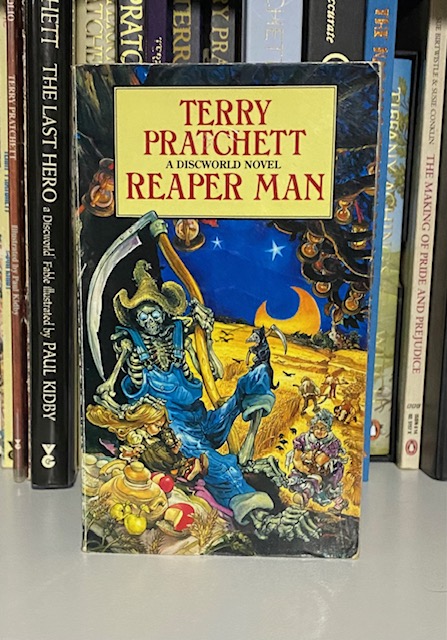
As I said in the last entry in this series, it was more than a year before I was able to read a new Discworld novel after buying the hardback of Moving Pictures. Reaper Man, the eleventh book in the series, was what I was waiting for.
But in paperback this time.
At first glance, I loved it. It seemed to be following some of the themes of Mort, in that Death, as an anthropomorphism of a natural process, was soaking up some of the attitudes and behaviours of the people that he was helping cross over to the other side. The powers-that-assume-they-are-being that supervise the other realms believe that his behaviour – Pratchett refers to Death as him, so I shall do so as well – is causing irregularities in the wider universe, so they sack him. Death therefore takes the opportunity to experience these “irregularities” with a little more interest than usual, deciding to pass himself off as a mortal for a while, working as a farmhand for the elderly Miss Flitwick.
Meanwhile, there’s another story happening in Ankh-Morpork (I haven’t mentioned the Disc’s premier city much in the last couple of posts but my obsession with it being a major character as well as the definitive/default setting in this series is still there). Windle Poons, the oldest wizard at Unseen University, is preparing to die. Because he’s a wizard he knows when he is due to shuffle off this mortal coil, and while his faculties aren’t as sharp as they used to be, his colleagues have given him a lovely send-off.
Unfortunately…
Sorry – bit tactless there.
Mysteriously, he hasn’t properly died. His body has stopped working but his mind is as sharp – sharper, in fact – than he has been used to it being for a long time. His colleagues try repeatedly to dispose of his corpse but he is just too active for that. So Windle heads out into the city to find a solution and meets a range of other characters suffering from the same plight as himself. While this is happening to him, there’s a range of mysterious objects materialising in places across the city…
Look, Reaper Man is a pretty important book in this series. Like Moving Pictures before it we meet a range of new characters who will play a fairly important role in the books to come: Mrs Cake, landlady and psychic; Reg Shoe, an undead rights activist; Ned Simnel, a blacksmith/engineer whose son will play a major role in a much later book; the Auditors, a collection of supernatural beings determined to rid the universe of any irregularities and replace them with proper order; and, finally, the faculty of Unseen University, soon to become stars of their own series of books.
Other recurring characters play minor roles here: C. M. O. T. Dibbler, the Librarian and the Patrician all turn up here, but they mostly add flavour and colour to the book rather than contribute to the plot.
There’s also the mysterious story of what happened to Mr Hong and his takeaway shop on Dagon Street. This will be referenced several times over the next few books but it never warrants its own story, alas.
So it’s packed to the gills with ingredients that should make this a brilliant story.
Well, it is amazingly popular in some circles. The Death-takes-another-holiday story is quite touching in places and features some wonderful moments as well as ensuring that Death has a much greater understanding of what humans are like by the end of it. The Wizards story takes a little longer to get going and what starts off as a quite blackly comic tale of an old man trying to make a fresh start after being retrenched (and then, quite literally, de-trenching himself) from his regular employment quickly becomes a retelling of Aliens with a rather good anti-capitalism spin to it. The thematic similarity of the two stories (Death being fired, Windle being… disposed of) makes them a nice pair of bookended stories in the one volume.
But it’s not one that I’ve ever really taken to. The Death story isn’t an issue, and the Windle Poons story isn’t too bad, either. And the Wizards on their first proper outing, after being introduced in Moving Pictures are a hoot as well, setting them out in the roles that they would play against each other in their remaining stories.
But the book itself is a big ball of energy without a real heart to it. The jokes are brilliant, the characters are wonderful (the fact that so many of them come back later is testament to that), but the book overall just leaves me flat.
The best comparison I can come up with for it is to Stephen King’s 1987 novel The Tommyknockers. This was the third book that King published that year after Dark Tower 3 and Misery. And it came in the year after his biggest novel, IT. Oh, and the outing of his pseudonym, Richard Bachman, happened in this timeframe as well. Tommyknockers is a book filled with manic energy, an interesting story and some wonderful insights. It’s also a mess, and the first book of King’s that I really didn’t enjoy. However, it is a magnificent failure that most writers could only dream of achieving. It fizzes with energy and subplots and characters and…
… it’s also a book that is filled with King absolutely hating himself and the condition he was in at the time. It’s telling that he didn’t publish another book for over a year after that (and when he did, it was the wonderful The Dark Half, a story about a writer trying to dispose of his evil alter-ego). Now, I am in no way suggesting that Terry Pratchett was fuelling his writing with cocaine, alcohol and self-loathing at this time but he was coming off a period of tremendous creativity (he had 5 books published in 1990, the year before Reaper Man was published) and he had just completed an exhausting and gruelling book tour with Neil Gaiman promoting their jointly-written Good Omens and I think that Reaper Man was a reaction to this sudden and explosive success. It was also the fifth book in a six-book contract and – according to Rob Wilkins’s biography, Terry Pratchett A Life With Footnotes – was also a period of concern for Terry that he had over-committed himself with the number of books that he had agreed to produce. As a result of this, he would never again sign a contract for more than two books in advance.
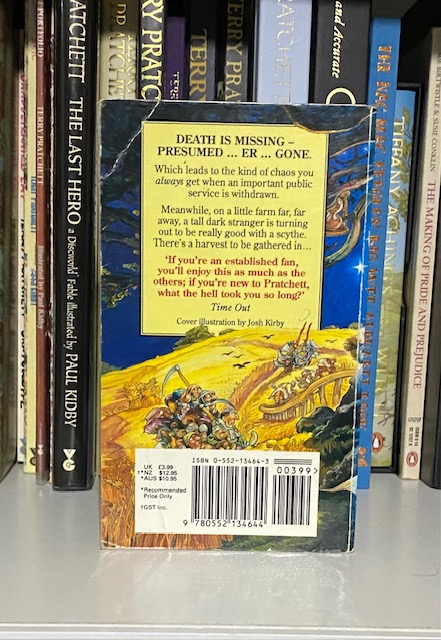
But let’s get back to Reaper Man. AS I said, the two plots complement each other nicely but they never really gelled for me as a coherent whole, and the leisurely pace of one is rather jarring when you place it against the breakneck speed of the other. I enjoy it and the fact that I usually read it in just one or two sessions each time I pick it up are reasons to think of it being a successful book but it just doesn’t resonate with me as much as the vast majority of the rest of them do. If they had come out as two separate volumes I might have bemoaned the shorter length but enjoyed them each more. I just don’t believe that the link between the two stories – Death being fired – is explored in a satisfactory manner, and the shopping centre monsters that the wizards go up against literally crop up out of nowhere with no really good explanation for it. There’s also the fact that many of the scenes in the shopping mall (which is quite wonderfully reimagined as the xenomorph lair from the aforementioned Aliens) made me think of similar moments from Truckers (one of the five books published by Pratchett in 1990).
No, this is one that I can read and enjoy, and just not get as much as so many other books in the series.
And, given the amount of enjoyment I have received from this series over the years, I’m quite okay with one or two of them not reaching me as far as the others do.
Coming up next: A fairy godmother makes Granny, Nanny and Magrat an offer they can’t refuse in Witches Abroad.

 Stuff Ian Likes
7 thoughts on “The Great Discworld Retrospective No. 11: Reaper Man”