When we last left the Witches, all the way back in Wyrd Sisters, things seemed to have settled down a little bit in the mountainous kingdom of Lancre. There was a new king who seemed prepared to give witches the respect they deserved, the coven of Granny Weatherwax, Nanny Ogg and Magrat Garlick appeared to be a little more settled with one another, and life was going on as it always had done.
However, a parcel arrives for Magrat as part of a behest from Desiderata Hollow, a recently deceased witch. It seemed that she had once moonlighted as a fairy godmother and wants Magrat to fulfill the destiny of one last young woman…

After the vague, undefinable disappointment of Reaper Man, this was like a breath of fresh air for me. It tells a pretty solid, though somewhat meandering, story featuring a set of characters that I adored. It also did for fairy tales what The Colour Of Magic did for heroic fantasy.
What it really is, though, is a big journey through the various lands of the Disc, many of which have been hinted at in previous books, some of which are completely new to this story.
It’s also a glorious romp through a lot of traditional stories and a few more modern ones. As the coven travel across the Disc to the ancient city of Genua, accompanied by Nanny’s murderous cat Greebo (“He’s a big softy, really”), they skewer a lot of cliches but they are also unwittingly following a trail left by Lilith, another fairy godmother, who was determined that life should be more like the stories she grew up with. As the witches progress on their way they begin to realise what they might be up against…
I love the journey across the Disc. The witches manage to defeat, often unwittingly, obstacles and stories set up by Lilith. The tone is set by their first proper encounter with a character from another story…
“Two pale glows appeared at the edge of the lamplight. Eventually they turned out to be the eyes of a small grey creature, vaguely froglike, paddling towards them on a log.
“It reached the boat. Long clammy fingers grabbed the side, and a lugubrious face rose level with Nanny Ogg’s.
“’’ullo,’ it said. ‘It’sss my birthday.’
All three of them stared at it for a while. Then Granny Weatherwax picked up an oar and hit it firmly over the head. There was a splash and a distant cursing.
“’Horrible little bugger,’ said Granny…
They then encounter variants on Dracula, Sleeping Beauty, Red Riding Hood… but it’s not until a house falls on Nanny’s head that the reader suspects just what this story might be leading up too – after all, in that story, a young girl was advised by one witch on how to deal with another. Granny is also realising just who they might be up against…
But eventually they reach Genua and make contact with Mrs Gogol, a powerful witch and cook, who is able to direct them to what they need to do: prevent a scullery girl, Ella, from marrying a prince.
They try everything, but eventually, they have to face down Lilith, the fairy godmother who rules Genua with wand of iron, and who has a secret that Granny has lived with her for most of her life:
‘I’m going to give you the hiding our Mam never gave you, Lily Weatherwax… because, and I wants you to understand this prop’ly, after you went I had to be the good one.’
For what is such a standard twist, this delivers a devastating realisation into Granny’s character. For a start, eagle-eyed readers will know that Granny is always on the side of “right” rather than of “good”, and that’s more than a matter of semantics. It would be easy to assume that this was because she didn’t hold with being a wicked witch; instead , it turns out that Granny had to be a “good” witch to avoid comparisons with her sister.
Eventually, Lilith is defeated, and the witches are make their way home, but they agree that they’ll take their time about it and, as Nanny puts it, “see the elephant.”
I loved this book when I first read it and I’ve only ever gotten more enjoyment from it as the years have passed. It’s got a story that works slowly but when you realise that every moment occurs for a reason, you don’t want to flick through to the denouement.
Frankly, though, I love a story that builds and Witches Abroad is superb at it. When you realise that all these encounters with fairy tales are not just plot points but also critiques on the nature of stories, you start to look at them with more serious eyes.
I know I did.
This has been one of my all-time favourite books in the series since I first read it back in 1993. I think it’s probably about this point that I started taking the books seriously as literature, as well. Frankly, my view is that any book that survives over time can be classed as “literature” because it keeps speaking to people about what they feel and believe, but that’s a conversation for another time.
But Witches Abroad has a lot to say about fiction and how seriously we should take it. Like most authors, Pratchett values stories and the role they have played in our history and culture but he doesn’t believe that they should be held over other things. There’s a chilling scene in this book where Lilith transforms some foot- and coachmen into small animals… and then kills them. It’s chilling because we’re used to it being the other way around in Cinderella, but it’s worse because we just met them a couple of pages earlier in the form of minor characters who could become some kind of comic relief.
Later in the book, Granny and Nanny need to be chaperoned to the ball and they transform Greebo into a human, a set of scenes which is played largely for laughs here and when it happens a few books later in Maskerade. But there’s that notion at the back of our mind about those poor guys who got murdered a little earlier after being transformed, and here’s another poor fellow who crossed Lilith’s path some years before and had to spend the rest of his days in the shape of a wolf. And that’s before we even consider Ella’s evil stepsisters and the prince (who may actually be in the wrong story…).
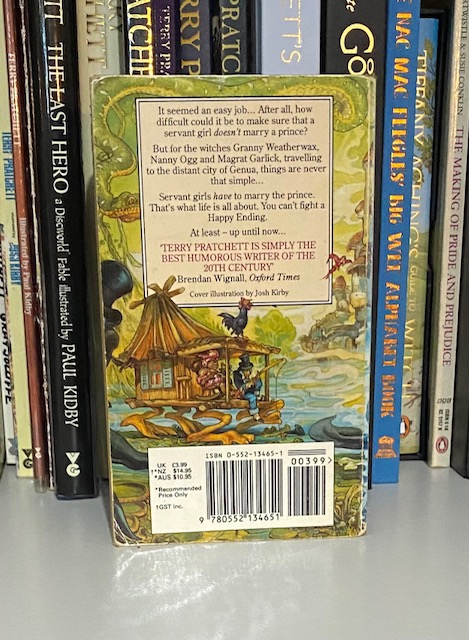
Stories are great, the witches eventually realise, but living in one is a completely different matter.
What became ironic to me, is that in our real world, the stories that I had loved as cult fantasy classics, were about to become known to the much wider public largely because of the next book…
Coming up next: The god Om realises that his only believer isn’t heavy, he’s his Brutha.

 Stuff Ian Likes
3 thoughts on “The Great Discworld Retrospective No. 12: Witches Abroad”