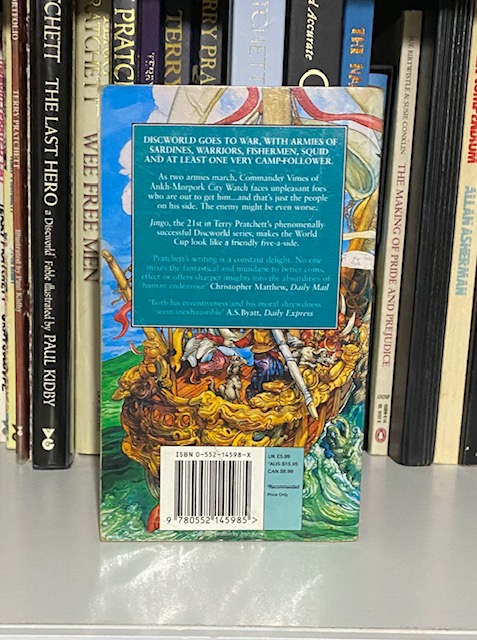
The start of Jingo features the introduction of the magical island of Leshp which makes a reappearance after being submerged for what appears to be most of recorded history and then, fairly predictably, becomes a pawn in the territorial disputes of the countries around the Circle Sea, chiefly the city of Ankh-Morpork and the country of Klatch.
It’s one of the last big manifestations of magical energy in the series, unfortunately: we get some large displays of magic throughout the remainder of the series, but the threats and plots never really loom as large as this again.

Which is fine because we get some terrific character and situation-based stories in their place, but sometimes you just long for a monstrous existential threat or mystery.
Anyway, seeing as how Leshp and its chthonic ruins are halfway between two countries that have enjoyed something resembling peace for some time now, it’s only natural that they should go to war over who owns this uncharted island.
Then, after an attempted assassination attempt on the Klatchian Prince Khufurah, Lord Vetinari (the Patrician) resigns from his post and hands over the control of Ankh-Morpork to the aristocracy. Led by Lord Rust (making his second appearance after being a minor character in Men At Arms), the lords of the city place Ankh-Morpork under martial law and raise their own private regiments, as they are entitled to under the rules of war. This annoys Commander Vimes who resigns as the head of the Watch (along with Carrot, Colon, Angua, Detritus and resigns himself to sitting back and watching the world go to pieces in front of him… until he remembers that as he is married to Lady Sybil Ramkin, he is entitled to raise his own private regiment for the war effort…
What begins as a pointed satire on the futility of war becomes a remarkably prescient novel about why we are so very keen to go to war even when we know just how terrible it is. I say prescient because Jingo was published slap bang between the two Gulf Wars, conflicts that a lot of folks believed we were dragged into because of the pecuniary interests of those we allow to govern us.
But Jingo is about so much more than war: Pratchett touches on conspiracy theory, geo-political relationships, the “othering” of minority groups within a culture in times of conflict, even on the idea of military competence and what a victory looks like (Lord Rust believes that there should be lots of corpses involved, but only slightly more on one side – so you can tell who won).
And the different stories that are being told throughout this novel encompass all the themes that great writers have tackled across the history of literature.
Vimes sees himself as someone who needs to go to war in order to ensure that as few lives as possible are lost; Angua goes on a mission for Vimes but is captured; Carrot sets off in search of Angua but discovers a streak of T. E. Lawrence in his character; while Colon and Nobby are recruited by the Patrician and his pet genius, Leonard of Quirm, for a secret mission in a new kind of marine vessel…
There are far too many things to summarise here, but it is a magnificent journey with a lot to say about how people can be whipped into a storm of passion about something that might not necessarily concern them and is almost certainly none of their business. The way that the people of Ankh-Morpork are convinced by their supposed betters that they are the victims of a vast injustice being enacted against them and that it is their duty to claim the island of Leshp as a strategic location to maintain Ankh-Morpork’s supremacy in the region. Of course, like people throughout our own history, this rhetoric is lapped up:
It was much better to imagine men in some smokey room somewhere, made mad and cynical by privilege and power, plotting over brandy. You had to cling to this sort of image, because if you didn’t then you might have to face the fact that bad things happened because ordinary people, the kind who brushed the dog and told the children bed time stories, were capable of then going out and doing horrible things to other ordinary people. It was so much easier to blame it on Them. It was bleakly depressing to think that They were Us. If it was Them, then nothing was anyone’s fault. If it was Us, then what did that make Me? After all, I’m one of Us. I must be. I’ve certainly never thought of myself as one of Them. No one ever thinks of themselves as one of Them. We’re always one of Us. It’s Them that do the bad things.
And then there’s Colon…
This was probably the book where I started to actively dislike Colon as a character: despite him being partially responsible for the death of a person in Guards! Guards!, I’ve often had a soft spot for him; however, he is openly racist in this book and his mean and nasty streak really comes to the fore. He realises that he might be wrong in some of his attitudes but he is resolutely back to being his old self by the start of the next Watch book where we get to see what he’s like when left unchecked. As Pratchett says:
Sergeant Colon had had a broad education. He’d been to the School of My Dad Always Said, the College of It Stands to Reason, and was now a postgraduate student at the University of What Some Bloke In the Pub Told Me.
Colon represents those of us who feel that the world is changing far too quickly and is leaving him behind. We can see him in countless other characters or people we know who realise all too late that what has always been the way that things have been done is no longer appropriate or even suitable and that they are starting to become increasingly irrelevant in areas where they have always been ahead of the crowd, or at least a part of it. Fortunately, Colon has Nobby to act as a sounding board for his ideas, despite Nobby often poking holes in them, but he also has loads of opportunities to update the way he does things in order to keep up with his peers. That he refuses to do so, choosing to pine for the less complicated world of his younger days, reflects terribly on his character.
But now that I’ve vented my spleen about Colon, let’s move on to Leshp, the MacGuffin of the novel.
Leshp is what is known in Science Fiction circles as a “Big Dumb Object.” It exists for the plot to revolve around it. Similar artefacts in other fiction include Rama from Arthur C. Clarke’s novel Rendezvous With Rama, the Excession from the Iain M. Banks novel of the same name and the Dome from Stephen King’s Under The Dome.
Leshp, from the glimpses we get of it, is a remnant of a prehistoric civilisation. There are hints of it being somewhat Lovecraftian in nature:
And everyone had looked around at the weed-covered buildings and had shared the Thought, which had remained unspoken but was made up of a lot of little thoughts like the occasional ripples in the pools, and the little splashes in the dark water of cellars that made the mind think of claws, winnowing the deeps, and the odd things that sometimes got washed up on beaches or turned up in nets.
Fortunately, though, that sense of uneasiness and indescribable horror doesn’t last. Which is a shame because it does end the story rather suddenly and a little too neatly for my liking.
Anyway, as I said at the start, this is one of the last times that we will get a major supernatural/magic event like this in the books. There’s a purely local happening in The Last Continent in a couple of books time, another go at the end of the world in Thief Of Time, and a disastrous, unnatural Winter in Wintersmith, but that is pretty much it for the rest of the series. Of course, there is plenty of magic happening in the rest of the books but not a lot that happens on this vast scale.
This was largely because Pratchett’s own priorities were changing. In his introduction to his revised edition of The Carpet People (his first novel, originally published in 1971, and revised in 1992) he said:
I wrote that in the days when I thought fantasy was all battles and kings. Now I’m inclined to think that the real concerns of fantasy ought to be about not having battles and doing without kings.
Speaking of kings, it was left fairly ambiguous at the end of Guards! Guards! which direction Carrot was going to take: we saw in Men At Arms and Feet Of Clay that he was seemingly the right person to step up and take the throne. But, perhaps not surprisingly, Carrot has been perfectly happy to remain as a humble watchman and leave the governing to those more suited to it. Or possibly even that he can do better as a policeman than as a king.
Which is probably the lesson that Pratchett means us to take from Jingo: those who crave power are the least suited to get it. It’s not an unusual or rare lesson, but it’s one that we keep on needing to learn, apparently.
Coming Up Next: Rincewind takes a trip to a great hubward land in The Last Continent.

 Stuff Ian Likes
2 thoughts on “The Great Discworld Retrospective No. 21: Jingo”