Devin Jones has taken a summer job at an amusement park hoping to get over the girl who broke his heart. As the summer progresses, though, he becomes embroiled in an old mystery concerning the murder of a local girl and the culprit who was never found…
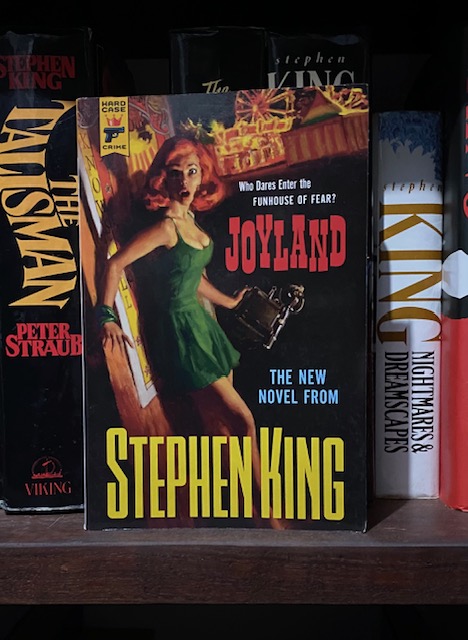
When I was younger I was a huge Stephen King fan. As I got older and my tastes began developing down particular pathways, we drifted apart but he was always there on the bestseller lists with another absolute cracker of a book. But until Joyland was published, I hadn’t read a new Stephen King novel in about a decade (it was Bag Of Bones, if you’re curious – and it wasn’t even that new at the time).
But Joyland was a book in the right place at the right time. I found it in my local bookshop in the Horror section. That in itself was an oddity because it was published under the Hard Case Crime imprint, a range of books that published new and classic pulp fiction in inexpensive editions. They’re a great range of books and having an author of the calibre of King contribute two novels to it was quite a coup. The first was The Colorado Kid, a mystery/character piece about a body that had been found on an isolated beach and never identified. It became the basis for the television series Haven, which ran for five years.
Joyland is a far better book. While it has all the accoutrements of a ghost story-cum-thriller, it’s really a coming of age story told as a memoir from several decades hence. Devin is remembering that summer because of a tragic event that has taken place in his more recent past, and he’s reliving that golden summer where everything was perfect.
Except that it wasn’t: Devin solves a mystery but he also discovers that someone who has been looking out for him is a serial murderer. The implication for the reader is that Devin is remembering a time when he had to face up to adult issues for the first time in order to better deal with the more recent event.
Appropriately enough for a novel set in an amusement park, Joyland is a wonderful ride. The climaxes and twists in this book aren’t as visceral or monumental as in King’s other works but that makes them all the more interesting.
Devin is intending to only work at the park for the summer but he finds himself staying on for the off-season and taking some time off from his studies. Part of that is the security of having work so that he can save up for his next stab at college, but it’s mostly because he finds some real satisfaction in his work and because Joyland is a proper refuge from the harsher world outside.
Part of what brings Devin that joy is the camaraderie he gets from working with the other carnies. King sprinkles the novel with examples of what Devin calls “The Talk”: the almost codelike lingo that carnies and travelling entertainers have used since about forever. This touch of verisimilitude amused me because I’d first encountered this cant in the Doctor Who story Carnival Of Monsters, in which the Doctor and his companion find themselves shrunk and trapped in a portable wildlife preserve. The showman in charge of the machine later talks to the Doctor, mistaking his costume as showbiz attire, in what the novelisation refers to as “palare.” To further a non-existent connection, Carnival Of Monsters was first broadcast in 1973, the year in which Joyland is set.
Speaking of costumes, Devin finds that one of the best things about working in the park is being rostered on for a shift as Howie, the park’s mascot. “Howie the Happy Hound” is a big dog who represents the park to the public. Kids love having their photo taken with him – he’s Joyland’s own Mickey Mouse, and Devin becomes so enamoured of the joy he gets and gives while “wearin’ the fur” (as the old hands refer to it) that he starts to lose a serious amount of weight and begins to become ill from dehydrating in it under a hot summer sun. He also saves a child’s life while wearing the suit which makes him a minor celebrity.
But there’s some quieter and more prosaic moments in his life away from the park. Devin rents a room by the beach and walks to work every day. One day he notices a woman and child on the beach. He sees them frequently and eventually – because the Summer has ended and there’s practically nobody else in town – becomes friends with them. Annie and Mike, as he discovers, are spending a lot of time at the hospital because Mike is terminally ill.
I’ll leave the story there because I’m going to venture into spoiler territory if I keep on going.
Something that I’ve always loved about the work of Stephen King is the way that he is able to tap into a reader’s subconscious and put them into a scene simply with a thought or a reference or a brief description of something. On the first page, Devin tells us something that immediately makes us want to take his side:
People think that first broken heart is sweet… Yet that first broken heart is always the most painful, the slowest to mend, and leaves the most visible scar. What’s so sweet about that?
We’ve learned that Devin is still hurting, but he still manages to show that he has a sensible, prosaic core to his soul. But later in those introductory scenes he says:
I’m in my sixties now, my hair is gray and I’m a prostate cancer survivor, but I still want to know why I wasn’t good enough for Wendy Keegan.
It’s a brilliant opening, telling us that Devin has matured but still hurts from that first rejection.
There are also some wonderful descriptions of the setting, as well. Devin falls in love with the small North Carolina town he works in, and that joy permeates all his descriptions… although that might be older Devin putting a rose-tinted spin on what he remembers of those days. But what it reminded me of was the description of the run-down hotel and amusement park where Jack Sawyer begins his story in The Talisman (which King co-wrote with Peter Straub in the early 1980s).
But, if we’re lucky, we all have a year like Devin relates in this book that we remember especially vividly because of heartbreak. I say lucky because if we do remember it with some bittersweetness we’ve managed to get over it. I remember my summer with almost perfect recall. I was working on a show and I had a summer job that my soon-to-be-ex had lined up for me so that we could work together. And then, just before we were about to start, she dropped the bombshell that she was having some second thoughts. About a week into the job, she confirmed them and we parted ways. Like Devin, I had wholly bought into the relationship. And for a long time – like Devin – I wondered why I wasn’t good enough.
Fortunately for me, I had a lot of friends around me who kept me busy and distracted but I remember so much more about that summer and autumn than I do about nearly any other time in my life.
So, yes, a lot of the appeal of this book is the way that it taps into that memory of a more innocent and optimistic time. But the story is wonderful as well. It’s leisurely but full of incident, which long-term readers know is right up my alley.
Plus, it’s King returning to the wonderful form that I remembered from when I was younger, which makes it doubly nostalgic.
But, please, don’t let that put you off reading it: it’s as tightly disciplined as anything King wrote at whatever peak you might think he had. And if, like me, you just adore his novels and stories that only flirt very briefly with the supernatural, this is a gem.
Because even though he is most famous for horror, a lot of King’s absolute best work is in fairly straight literature. I’m thinking specifically of Different Seasons, his 1982 collection of novellas that he had been unable to find a home for anywhere else. Two of them, “The Body” and “Rita Hayworth And Shawshank Redemption” are amongst the best things he has ever written (you may also be familiar with the movies that were made from them, as well) and the other two (“Apt Pupil” and “The Breathing Method”) are really good as well. Only one of them resembles a horror story, and it’s the sort of subtly terrifying cosmic horror that was popularised by The Twilight Zone and other venues, and which plays an almost incidental role in the story.
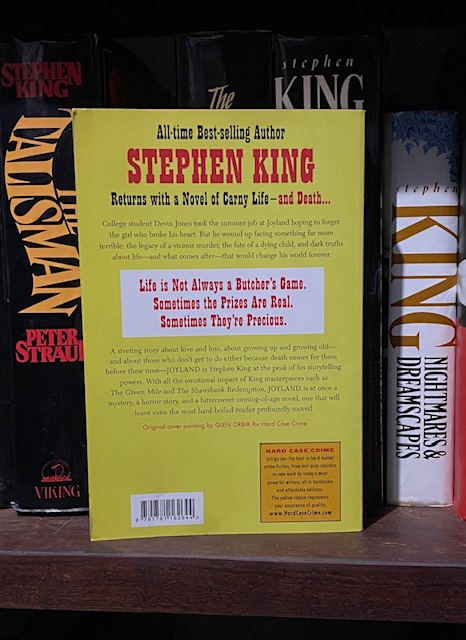
Joyland takes you on a similar ride to a time when everything seemed possible if you just had the nous and grit to stick at it, but when problems could also appear to be insurmountable. It reminds you of what you were like and what you thought you were capable of. It reminds you of what it was like to discover those resources that you thought only other people had. It reminds you of the unbelievable vastness of the future before it started to shrink in front of you.
Joyland reminds you.
You can find out more about Stephen king at https://stephenking.com/

 Stuff Ian Likes
One thought on “A Novel Ian Likes: Joyland by Stephen King”