Now Ego is on the stage and walking swirly-burly. A thought. What a strange word ‘stage’ is: sta-ge, ssssssstttttttaaaaaagggggeeeeeeee, stage.
Trembling, Ego reaches the microphone (so no need to project). ‘Must speak,’ thinks Ego, ‘must kiss. No, must speak first – then kiss.’ Words tumble.
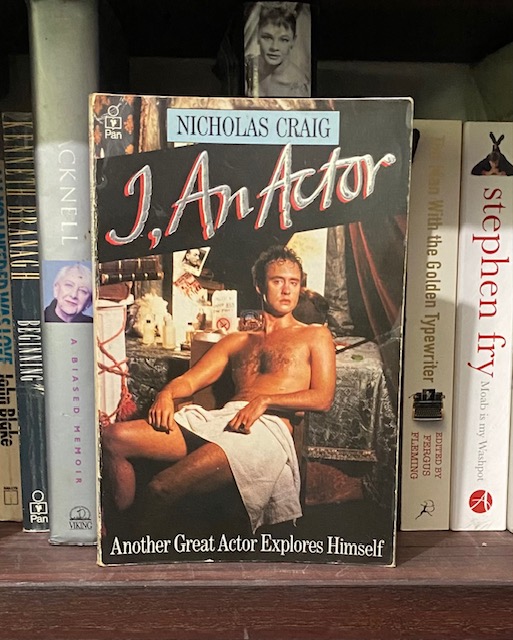
Nicholas Craig’s memoir begins, like all the best showbiz memoirs, at a pivotal point in his career. He’s accepting an award as BEST ACTOR IN A HITHERTO UNPERFORMED LATE-JACOBEAN TRAGEDY, 1982. Throughout that moment, he reflects on what it means to accept an award, from the feeling of surprise, the filing away of how he looks and moves in case he needs to replicate it in a performance, through to the moment when he considers that there should be no awards in such a fraternal business as acting and that to see engraved on a statue that you are a better actor than your peers is just embarrassing to everyone.
But still…
I, An Actor is a wonderful spoof of an actor’s autobiography. It was conceived by the authors, Christopher Douglas and Nigel Planer, as an antidote to the overblown tomes written by the great and prominent actors of their day, trying to explain their job and failing utterly by comparing it to mountain-climbing or some other ridiculous exercise. The fact that several of those actors saw the book as a personal insult shows just how effective a portrayal it was.
For someone like me, who had spent the previous several years reading rather more biographies of actors than should be considered healthy, this was a revelation. Every part of the book was riddled with veiled and not-so-veiled digs at the clichés of the theatrical memoir. Craig refers to a distant relationship with his father – there are any number of actors who had fathers who disapproved of the careers their children picked, but the disapproval subtext is usually based around the insecurity of the profession and the fear of the parent of having to bail out their offspring when everything goes pear-shaped. However, this distance was occasioned by Craig and his mother making fun of him. In the absence of his father, he is left to be raised by his mother, referred to hereafter as “Mim.”
From his childhood we move to his first experiences on stage, wherein he suffers from several wardrobe malfunctions that expose, as he says, “more than the plot.” This sort of attention-seeking behaviour does not endear him to his Headmaster, and he implies that his success since then may have been all a deliberate effort to snub this early doubter.
After the brief biographical information – all that his missing is the story of what his grandparents did and how his parents met – we move to the story of his acting career.
It begins in the late 1960s in some briefly discussed productions that he glosses over in favour of his first big breaks, which accompanies a lot of discussion about how real actors don’t crave fame and fortune, rather the sense of achievement given by successfully tackling a challenging role.
He then, of course, becomes a household name through his role in a series of ads and a successful sitcom…
At the time I first read this book, I was in awe of actors and what they could do on stage. Having been in a few plays myself at this point, I had a rather over-inflated sense of kinship with a lot of the subjects of theatrical biographies. I, An Actor was the perfect pinprick to my ballooned sense of self-importance.
It helped that it was hilarious as well. Douglas and Planer were both established in their own careers at this time so they could probably afford to take any hits that these unveiled digs at their colleagues and peers might have cost them.
The problem comes from it being so well-judged and accurate. I had read Laurence Olivier’s memoir, On Acting, just a couple of years previously, and this seemed to be a direct response to that. There’s a moment in that where Lord Olivier is performing as Tagg in Trevor Griffiths’ play The Party:
The door at the back of the theatre opens, then shuts again. Someone has left. Who? John, Trevor? Doesn’t matter now. I’m on the runway… I’m motoring.
‘Don’t get too confident, Olivier. That’s when he’ll get you, the bogeyman who steals the lines before they reach your lips. Have respect.’
‘Must be halfway through. Not many coughs. They’re listening, by God, they’re listening.’
Compare that to Craig’s pastiche at the beginning of this post and there’s only a slight difference between the two. Although, in Sir Larry’s defense, he was just emulating what dozens of other actors had tried to express when imagining the stream-of-consciousness that goes on inside your head when you’re on stage. He also does a beautiful send-up of the same sort of process earlier in the book when he’s talking about how a veteran actor takes a curtain call:
Eyes take in the gallery, hold for a moment.
Eyes take in the upper circle, hold for another moment.
Eyes to the dress circle, longer hold, more money there.
But back to Craig…
In every theatrical biography, there seems to be a diary kept of the subject’s journey towards creating a role for a production. Kenneth Branagh did it in his memoir, Beginning, when he detailed the shoot of Henry V; Antony Sher did it in Year Of The King for his production of Richard III. Craig gives us a glimpse into the psyche of an actor for his season of The Dogs Of Tblonsk, a political allegory from behind the Iron Curtain. It’s very obviously a fictional play but the way it’s constructed – the characters are all dogs but with some very human concerns – and the fact that it’s an obscure play translated from a “banned” text – means that it’s quite easy to see where the barbs are aimed. There are also some just plain straight-up funny jokes in it, as well:
1st June
Towzha comes on in leaps and bounds. Bill wanted me to enter normally but I think my instincts are right.
Of course, Craig offers some vital tips for a young actor on the rise: how to pick out the right opening night gift; how to exclude the person in the cast that nobody likes without them noticing; the right way to deal with “ordinary people” when you are out after a show…
For a decidedly slim volume, this contains a remarkable number of truly good jokes. But there’s a life to it beyond the page as I discovered while doing my research for this very column…
… it turns out that Nicholas Craig was a genuine phenomenon on television and radio after the publication of this book. Played by Nigel Planer, he offered masterclasses on different styles of acting, frequently using footage from genuine movies and television shows to back up his lessons. During the Covid lockdowns, Planer and Douglas released several more videos from Craig on various arcane acting subjects as well. Viewed as a whole, they are an amazing catalogue of hilarious “how-to” guides to the widest possible range of acting jobs – period drama; science fiction; playing an old character; travel shows; cooking programmes… he offers the fruits of his vast experience to anyone who is willing to learn from him.
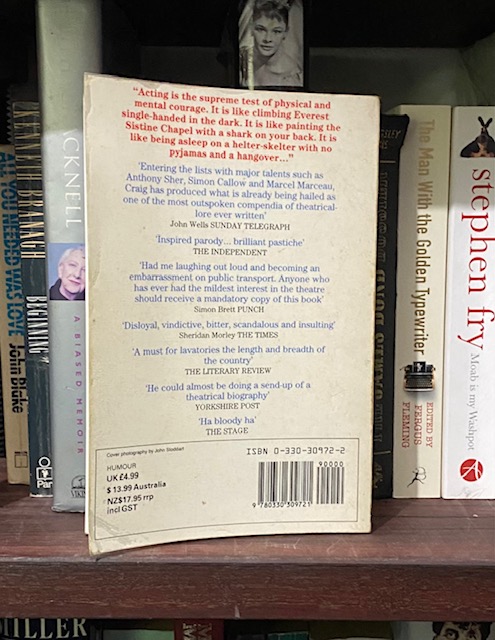
Of course, what I haven’t mentioned is that the thin persona of a suave, intellectual, sophisticated actor doesn’t really convince anyone. You’ve only got to look at the literary mysteries that confound him to realise this:
…why did Wilfred Owen’s creative juices dry up after 1918? What was wrong with E. E. Cummings’s shift key?
And he is also a thoroughly mean-spirited person as well:
(Shakespeare) tells you to go fast when the jokes are in Latin, he tells you to be louder when the girl is in a transparent costume.
In the more recent YouTube videos and in his podcast, we also meet his son Lysander, who is frequently browbeaten and ignored by his father, but who nonetheless expects full devotion from him. It’s an unsubtle critique of some actors who are more devoted to their career (and talking about it) than to anything else in their lives, but it makes the somewhat nebulously arrogant Craig a little more focused and nuanced.
It’s also a way for Planer and Douglas to highlight the real point of Craig: that his life is empty because he hasn’t experienced the joy that a satisfactory inner life can bring.
You can find out more about Nicholas Craig at https://www.youtube.com/@nigelplaner7720/videos

 Stuff Ian Likes
2 thoughts on “A “Biography” Ian Likes: I, An Actor by Nicholas Craig”