Susan Sto Helit, daughter of Mort and Ysabell, granddaughter of Death, has taken up a teaching position, discovering that she is rather good at it, too. She has achieved some degree of normality, and even her ability to manipulate reality has become something that she utilises with much less of the disdain and doubt that she did previously. She is, therefore, slightly annoyed when she is called upon to do battle on behalf of the world for her grandfather…
Meanwhile, two young men – Jeremy Clockson and Lobsang Ludd – are discovering that they have a very special and unique relationship with time. And a young lady named Myria LeJean is discovering that human life is much more complicated than she had previously been led to believe…
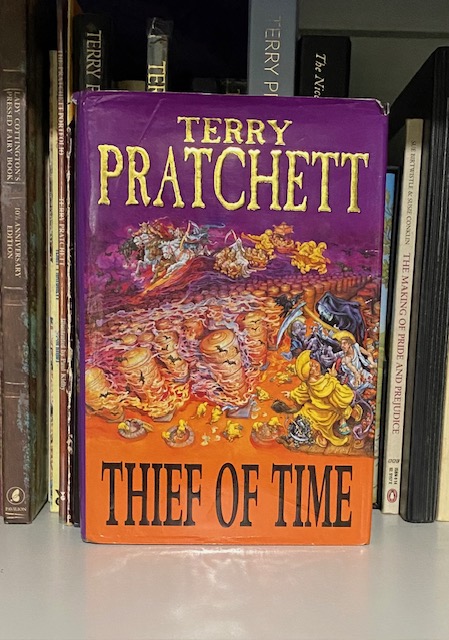
It’s difficult to summarise Thief Of Time with any degree of accuracy because it has a very complex plot with a larger than normal cast of characters. What it does have, though, is the usual delightful mix of genres (kung fu movie, time travel story and heist/caper) that we get in so many of the other Discworld novels.
I mentioned last time that Terry Pratchett was moving into a new phase of his career with the more recent books in the series. Thief Of Time feels like a deceptive return to the old style of Discworld novel, but it has a more literary tone and quite a bit more bite to it. If you compare it to Soul Music, the first novel featuring Susan, you will find a greater mastery of character and plot: where that novel features a lot of slapstick and a reasonable amount of humanity within its thin plot, this one is an absolute belter that satisfies the reader on so many more levels. And, if I can get a bit meta, Soul Music features Susan as a student, whereas here she is a teacher. A master, if you will. Other characters undergo a similar kind of growth throughout the pages of this book, but Susan’s journey throughout the story marks it out as a proper theme.
And Pratchett himself is making an effort here to master his world, too, by dealing with the inconsistencies of the previous books.
In the past, he had responded to efforts by fans to point out inconsistencies in the text quite dismissively. But there now existed books, maps and websites full of fannish efforts at chronicling and placing the events of Discworld into some coherent order, so he may have realised that something needed to be done.
Essentially, it’s the fault of the time-jump spell that the Witches cast in Wyrd Sisters.
In that book, the coven need the heir to the throne of Lancre to grow up and return pretty damned quickly in order to save it, so they cast a spell upon the entire kingdom and move it forward 15 years in time (in terms of what happens in the climax of that book, it was actually a pretty unnecessary spell).
There’s also the case of distance on the Disc: in Equal Rites, Granny and Esk take a trip to Ankh-Morpork that lasts quite a long time and features many obstacles: in later books, it becomes a case of taking a couple of stages by coach to get there, although you can write that one off as there being more than one way to get to Ankh-Morpork. There are other examples too, but that is the most obvious.
Also in Wyrd Sisters, Hwel the playwright wants a theatre unlike anything ever seen in Ankh-Morpork before. But just a few years later in Maskerade, Granny and Nanny visit the venerable Opera House which has a rich and storied history that seems to predate Hwel’s dreams.
In theory, most of us understand that the Discworld novels are comedies and that in comedy, jokes trump logic. But fans take things notoriously seriously, of course, and Pratchett decided to throw them a bone (but not, I assure you, one belonging to our favourite anthropomorphised concept of life’s ephemerality).
So, in Thief Of Time, we have what appears to be the best solution to these continuity errors: there was an accident with a time machine and years exploded into the past and future where they had no logical reason to be, creating a load of inconsistencies that the caretakers of these machines (the History Monks as they are known) are spending a lot of time cleaning up.
The History Monks have been mentioned before (most famously in Small Gods) and here we meet one of their most famous members: Lu-Tze, known as the Sweeper. Deceptively efficient – who notices a wizened little old man sweeping things up? – and respected and feared by all the other monks, he is one of the major characters in this book. He will also pop up again in a couple of books time, when he encounters the force of nature that is Samuel Vimes (in a story that occurs in part alongside this novel).
I realise that my efforts at explaining this story in a spoiler-free way make it difficult to get a real feel for what the book is like. Suffice it to say that this is a gem – I haven’t even mentioned the Auditors (making their final appearance in this book), nor have I mentioned the amazing Ronnie Soak, the former Horseman of the Apocalypse (who left before they became famous), whose name was something that Pratchett had chosen for its sound and feel before realising that it could be read backwards, revealing a perfect name for a harbinger of doom.
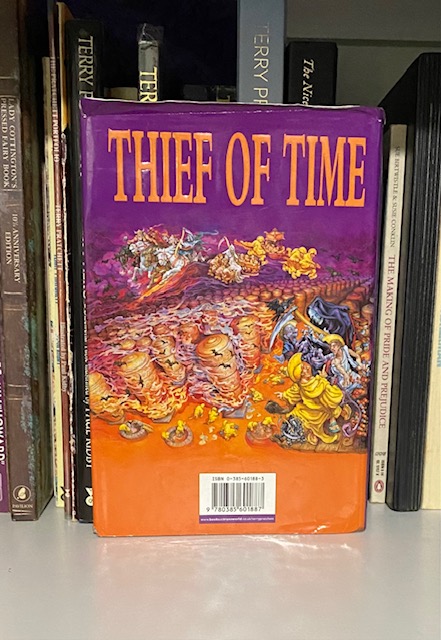
But Thief Of Time is also famous for a sad reason: it was the last Discworld novel with a cover illustration by Josh Kirby, whose work had decorated all the previous books. Kirby passed away in 2001, not long after this book was first published, after a career that spanned 50 years. His work was controversial and divisive amongst many fans, but I always enjoyed it, feeling that it captured the feel of the books in a way that a lot of other cover art failed at.
So Thief Of Time marks several milestones in Discworld: the last Kirby cover; an attempt at unifying the disparate elements of the timeline; the last book in which Susan and Death were major characters; and one of the last times that the entirety of Discworld faces a serious threat to its existence. This last point had been coming for a while: in his 1991 foreword to the revised edition of his debut novel The Carpet People, Pratchett wrote that:
“I thought fantasy was all battles and kings. Now I’m inclined to think that the real concerns of fantasy ought to be about not having battles and doing without kings.”
Pratchett hadn’t been featuring evil overlords for many novels now. The Auditors were a last gasp towards that in their first showing all the way back in Reaper Man. Their subsequent appearances in Hogfather and here just confirm that most existential threats that were given some kind of life in fantasy really didn’t have a grasp on what they desired, or that they just wanted to destroy what they didn’t really understand. In his later novels, Pratchett preferred to look further inwards to find his villains, exploring the darker side of people who crave power and why it is never a good idea to let them have it, and it’s there that we find some of the most brilliant and memorable stories.
Coming Up Next: We get a crossover event featuring some of the Disc’s greatest characters in The Last Hero.

 Stuff Ian Likes
One thought on “The Great Discworld Retrospective No. 26: Thief Of Time”