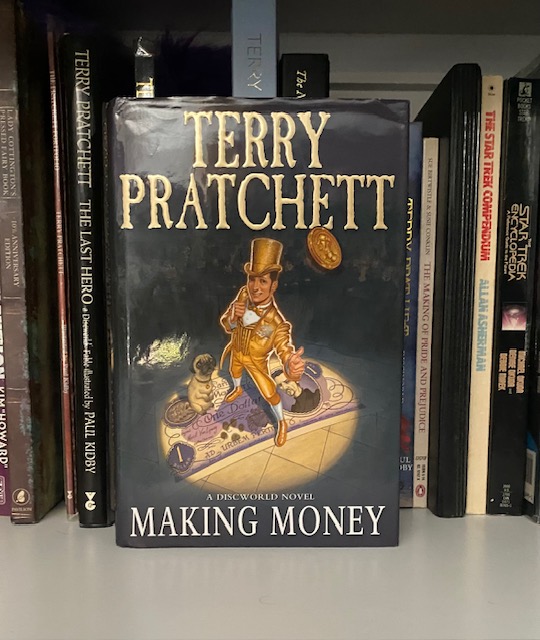
Moist Von Lipwig has been charged by the Patrician with looking after Ankh-Morpork’s Mint. He goes to his first meeting and then, by a random chain of events, manages to also be placed in charge of Ankh-Morpork’s banking system as well…
In Going Postal, we met Moist, the former conman. He was about to be hung in the opening chapter of that book, but the Patrician intervened and put him in charge of the Post Office, which he managed to turn from a ruin into a success. In this sequel, Lord Vetinari hopes that Moist can use his not inconsiderable charm and wit to save the economy.

I started off Going Postal not liking Moist because I personally dislike redemption stories that involve complete scoundrels seeing the error of their ways and going on to lead a blameless existence thereafter. Fortunately, Terry Pratchett avoids this temptation by having Moist become addicted to extreme experiences, like breaking into empty buildings, or racing across Ankh-Morpork’s skyline of a nighttime. Of course, he only engages in these activities when his beloved Adorabelle Dearheart is away from the city rescuing golems. But even these relatively harmless activities become redundant when he becomes the guardian of Mr Fusspot, a small dog who has inherited a majority share of the bank, and manages to attract the attention of Cosmo Lavish, aristocrat, director of the bank and possessor of a dream to become the Patrician in a rather singular sense…
What follows is a wonderful caper that explores Moist’s not-quite-reformed character with a certain amount of depth. He is, of course, a ridiculously attractive character to those around him, especially those who have the most reason to despise him…
…I’m sorry: like in Going Postal, I just find a character who reminds me of the chancers who make a living profiting off the gullibility of others in our Roundworld to be a completely unattractive protagonist. But that’s just me: inconsistently, of course, I find The Stainless Steel Rat books to be totally charming and they feature a character who should be as unattractive to me as Moist is.
And it’s not that he’s complicated – he’s just a conman who had one last opportunity to go straight and took it. The fact that he really doesn’t face that big a struggle to stay honest – saving his adrenaline addiction, of course – because of the challenges that Vetinari throws his way just make him a little more unlikeable.
To illustrate this, there’s a moment when Moist is on the verge of opening the Bank to the regular folks of Ankh-Morpork:
… someone called out: “Are you going to make us all rich, Mr Lipwig?”
Oh damn, thought Moist. Why are they all here?
“Well, I’m going to do my best to get my hands on your money!” he promised.
This got a cheer. Moist wasn’t surprised. Tell someone you were going to rob them and all that happened was that you got a reputation as a truthful man.
Ho bloody ho. This line was published literally months before the Global Financial Crisis, also known as The Great Recession, which was caused/exacerbated by folks who tried to squeeze a few extra notes out of an exhausted wallet. I was lucky and wasn’t hurt badly by that event, but it made me even more wary than I already was of smooth-talking whizzes who were always ready to spend other people’s money.
So yeah, while the plot is a well-paced riot, the subtext – in which Pratchett managed to be just as angry at merchant bankers (which is also a piece of rhyming slang) as he was at investors in Going Postal – was a great comfort to me.
But, really, whatever it’s attractions, it’s hard to talk about this book without mentioning the (fifth) elephant in the room that completely overshadowed its release. Because a couple of months after this book was published, Terry Pratchett announced that he had been diagnosed with Alzheimer’s Disease. It was a massive surprise because he was only 59 when the iitial diagnosis came, making his doctor and some specialists suspect that it may have been something else.
This was a huge upset at the time. And it’s still vivid to me. However, in true Pratchett fashion, he managed to turn it into a source of bittersweet amusement, possibly as a means of therapy. He immediately donated US$1 Million to Alzheimer’s research, encouraging his fans to also donate and “Match It For Pratchett.” He was also pleased that for a month he had managed to be the most Googled person on the planet.
We’ll be talking further about the impact that Pratchett’s illness – or “embuggerance” as he frequently referred to it – in most of the upcoming books, so we shan’t dwell too much further on it here.
So, back to Making Money. By novel’s end, we have achieved a measure of happy endings: characters have received their rewards or their deserts (possibly pineapple-flavoured thanks to the actions of a renegade from the Fool’s Guild, making their first proper return to the series since Men At Arms), and all is back as it was at the start of the novel.
Not quite, though. There’s a hint in the final pages of what lies ahead for Moist, and there also hints of what the Patrician has planned for the future of Ankh-Morpork.
Unfortunately, that hinted at future novel was never written, though this is not the last book featuring Moist as a lead character. However we do see many of the Patrician’s ideas for improving Ankh-Morpork – and, by extension, the Disc – beginning to take shape in the future novels, almost as though Pratchett was taking pains to ensure that things would be moving ahead in a vaguely positive manner without him…
Coming Up Next: The Wizards of Unseen University must fulfill a contractual obligation in Unseen Academicals…

 Stuff Ian Likes
One thought on “The Great Discworld Retrospective No. 36: Making Money”