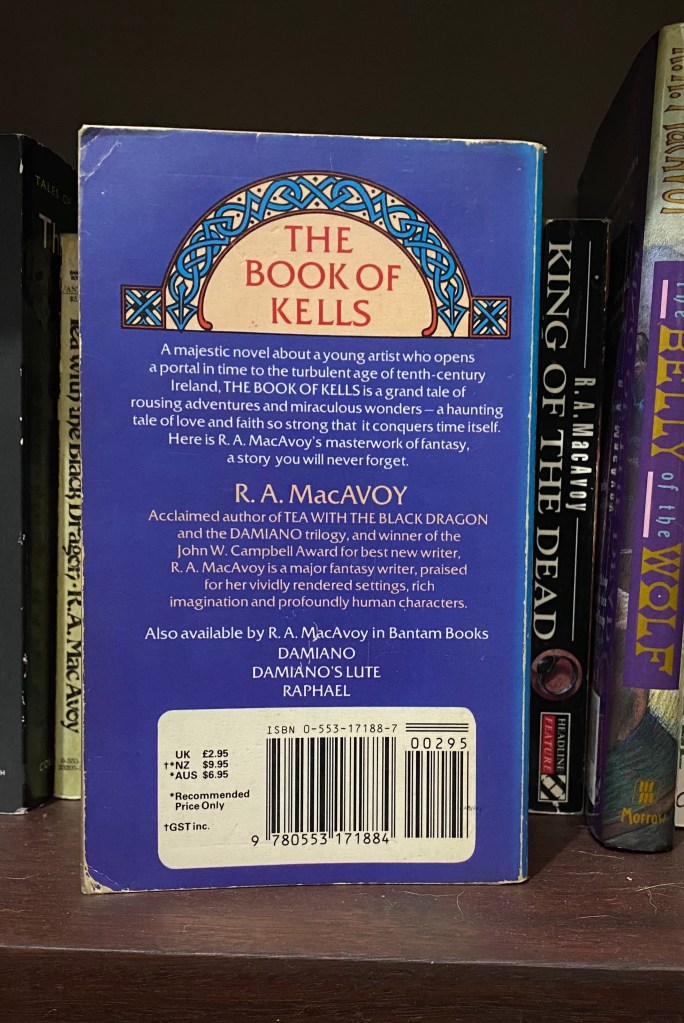
John Thornburn is an artist, recruited to teach in Ireland by historian Derval Keane. He has come because he is a huge fan of ancient Irish art. But one day he mysteriously opens a doorway into tenth-century history. He and Derval unwittingly become a part of the history they have studied…
R. A. MacAvoy burst onto the Fantasy world with her award-winning debut novel Tea With The Black Dragon in 1983. She followed this unconventional first novel up with her Damiano trilogy, set in fourteenth-century Italy. All four of these novels were hailed by critics but somehow failed to set the world aflame. The Book Of Kells (1985) was her fifth novel, and it was just as different from those previous books as they were from each other.

For one thing, it was partly co-written. MacAvoy acknowledges the work of Sharon Devlin who worked with her on the book and who wrote all the poems in it as well. The novel is listed in several sources as being co-written with Devlin; MacAvoy also writes on her dedication page:
All that is worthwhile in the book is hers; the errors are my own.
I have been unable to firmly pin down just who Sharon Devlin is: my best guess based on the available information I have been able to access is that she is a historian/occult expert specialising in Irish history.
At any rate this novel was as well received as MacAvoy’s other works but remained remarkably unread outside the fantasy readership.
Which is a shame because she is precisely the sort of author that enhances the genre with her writing: she is quirky, witty, insightful, literary and manages to tell stories that are quite different to the regular sort of novels that we might ordinarily read, and also coming at them from a slightly different angle.
However, she is not what you might call a commercial writer. After the release of Tea With The Black Dragon, her publishers wanted her to capitalise on that success with a more commercial novel. She presented them with Damiano, the story of a young wizard in post-Black Death, pre-Renaissance Italy. While it started in a commercially strong way (Damiano wants to protect his city from a marauding general, so he makes a deal with the devil), the succeeding volumes told gradually smaller and smaller stories that focused on the core characters and their more personal, less epic adventures.
She followed this trilogy up with the novel under discussion here, The Book Of Kells. It was the longest novel she had written thus far (which remains her longest book) and seemed perfect to cash in on the mania for Irish/Celtic-inspired fantasy that ruled the marketplace in the 1980s.
It’s an absolute cracker of a novel, frankly. John and Derval’s adventures and experiences in 10th Century Ireland are graphic and thrilling, as they dodge a Viking raid, then fail to enlist the king of Ireland to their cause, winding up taking matters into their own hands.
Let’s take a closer look at the story before we go much further.
Through some sort of magic, inspired by John’s affinity for his art combined with some musical magic, Ailesh comes forward in time. She is a young Irish girl who has been transported into the future, escaping from the Viking gang who are destroying her village and killing her family and friends. John, unable to understand what she is saying, calls Derval to come help him out. Eventually they realise that Ailesh has travelled forward in time and are able to recreate the circumstances, returning her to her time, but with them in tow. They find Labres MacCullen, a poet wounded in the raid, currently in a bit of bind concerning his career, and they make their escape, travelling to Dublin to bring their case towards the king who, they hope, will send a band of troops to avenge the massacre.
Alas, he doesn’t: Labres, angered by the apathy of his ruler, manages to offend him and the group barely escape Dublin with their lives. They travel towards a monastery to seek further counsel from the abbot. Unfortunately, they are trailed by the Vikings, whose leader, Holvar, has dedicated the entirety of Ailesh’s village to Odin. His honour and faith demand that he lead his men across Ireland to capture Ailesh and Labres and kill them.
It all leads to one of the most memorable final battles I have ever read in my life.
The whole book is beautifully written and is a wonderful, gripping story. But it failed to capture the popular imagination and it faded into obscurity not long after it was published.
Part of it was MacAvoy’s idiosyncratic style: her writing, as I said, is lovely and witty, but she creates characters that can be difficult to relate to or empathise with. John, for example, is an artist. He works in stone, so we know that he is patient and careful. But he’s also scatter-brained and forgetful, as well as small and physically weak. However, he is fortunate to fall through time to a culture that respects and understands artists and their foibles. However, he is a very frustrating character to read about because he is highly reliant upon the other characters to keep him safe, despite his natural talent for finding friends wherever he goes.
Derval is a fierce and intelligent woman who is responsible for John being in Ireland: she recruited him as a part-time tutor to the university where she lectures in History. She is physically imposing and strong, but also strong-willed and quick to anger. A keen athlete and horsewoman, she relishes the challenges that their excursion to the tenth century brings, but an encounter with an old woman who is later revealed to be Bridget, a Celtic goddess (or a Christian saint (or both)) unnerves and humbles her.
She and John are also lovers. Their relationship is not exclusive, but it’s deeper than what we might describe as “friends with benefits” these days.
So, these characters are already breaking the traditional fantasy adventure mould as it stood forty years ago. But they are also hugely interesting characters. I mean, you don’t have to know much about the academic world in the 1980s to know that Derval has had to be tough and unconventional in order to survive professionally, whereas John just muddles his way through life, letting his talents lead him wherever they take him.
Now, in a conventional, commercial fantasy novel, you might expect their relationship to deepen into something more solid and permanent. But MacAvoy is too realistic and honest a writer to do that: Derval and John are a great team, but they aren’t compatible beyond their basic physical attraction to each other.
This spikiness between the characters, as well as their effective role reversal from what we were familiar with from other stories, is part of why Ithink The Book Of Kells is long overdue a reappraisal. These two protagonists, as well as their approaches to life, are very well-suited to modern storytelling and expectations.
And John’s obsession with his art and his poor social skills mark him out as a possibly neurodivergent personality. There’s a lovely scene fairly early on in the book where he is in a sweathouse in a village and discovers a lump of charcoal and a blank wall. Inspiration seizes him and he decorates the building’s interior with pictures:
On the back wall… was Bridget, with her calm cow eyes and her hair coiling outward, enclosing all creation. There about her were the wren and the heron, the ouzel and the osprey. There among them stood a penguin in full dress, not drawn realistically but quite recognizable. Around the saint ran deer and camels and bison, and a thing Derval alone recognized as a Morris Mini Minor, its tiny wheels filled with tinier patterns of spirals.
Later on in the book he makes friends with a sailor through him drawing pictures to show how to solve a problem with boats infested with woodworms (John, coming from Newfoundland, is a capable sailor and his knowledge of knots and boats is an asset in his sculpting). He uses his talent and skills to build relationships among people who accept his differences as part of his gift.
Derval, on the other hand, is a slightly more conventional heroine: she is a skilled at riding and other outdoors skills. It is she who successfully manages to bring her friends out of the besieged village at the start of the novel without being noticed by the Vikings. She is the one who manages to use her knowledge of ancient Ireland to enable the group to make their way across the now-unfamiliar landscape.
And she uses that knowledge in a way that feels organic to the plot: in a lot of portal/time travel stories the heroes sometimes use knowledge to trick and cajole the inhabitants of the world they live in. Unlike Allan Quatermain in King Solomon’s Mines, Derval doesn’t have an almanac to tell her when the next eclipse is going to be; nor does she have some handily-dispensed-earlier-in-the-book knowledge of the local landscape and history to get out of a tricky situation (a plot device that annoys me no end when it is used in other stories). Her being a university lecturer in history might be extremely handy for the plot, but it makes sense for the story for her to be an expert in these things, since her knowledge and connection to John set the whole thing in motion.
There’s a lot else to love here as well: when making a lightning trip back to the present day (completely by accident) John sets out to get Derval’s horse for her, thinking that he might be a useful tool in the clash with the Vikings. Tinker, for that is his name, is stabled at a farm in Wicklow County. A farm owned by Anne McCaffrey, whose hugely unexpected appearance in this novel made me squeal in delight. And when John makes his return to the tenth century, he brings with him something that he knows will be of value to Ailesh in her future: steel needles, to make her sewing easier, and to trade since they would be astonishingly valuable in her time.
But back to Tinker, because his brief appearances in this novel are a delight. When John tries to ride him back to the monastery, he finds that Tinker has slipped his bit and is the only one of the twentieth-century characters to actually enjoy being in the past and we get a brief scene in which he is the point-of-view character:
No autos, no paved surfaces on which one might skid onto one’s bleeding knees, no crowds, no loudspeakers and no fences one must plan in advance. Tinker passed an hour without altering stride.
But it isn’t always pleasant to be in the past: there’s still the Vikings to contend with. And these characters are excellent villains. We really only spend time in the company of Holvar as a character, but he gives us an ample explanation for what he and his crew are about. He’s facing strife at home and he was hoping to use this trip to bring some treasure and prestige back into his life. He’s also struggling with maintaining his leadership among his men. On top of this, he’s facing a problem: as he’s gotten older, he’s finding that he can’t maintain a berserk rage during battle any more, which could cause him to lose face during fights, if his men ever find out. It’s a fairly thinly-disguised midlife crisis that Holvar is going through, frankly.
(And, given the renewed interest and possible rehabilitation given to Vikings in recent years, this is yet another reason why a modern audience might find something to appreciate in this novel.)
All these things might make him a fairly sympathetic character, though… until you realise that his men have just raided a village, raping and murdering all of its inhabitants. Any other chance of Holvar gaining the reader’s sympathy are also destroyed by the casual violence inflicted on innocent passersby as the raiders make their way towards Ailesh and Labres in their quest to destroy the last survivors of the village… But Holvar is also a poet, and he and Labres do engage in what can only be described as an epic rap battle before the final conflict.
Ailesh, too, could be a bone of contention for some modern readers, as well. Well, not just Ailesh, but her relationship with the other characters, specifically John. I have to let loose a spoiler here by saying that she crushes pretty hard on John, largely because he is an artist like her father, providing a link to her shattered past, but also because his gentle nature is unlike any treatment she has experienced from men before, especially from the Vikings.
She is 16 in the novel. John is 29. It’s an age gap that I felt was quite off-putting when I first read the novel back in 1987 (I was 17), and it’s possibly the one aspect of the novel that might put a lot of people off it now. John remains oblivious to her growing attraction to him, but he elects to stay in the tenth century by novel’s end, while Derval and Labres (who have begun their own relationship by this time) travel back to the future. An age gap like this is something that we are used to in medieval fantasies and classic literature – and even in a lot of other novels contemporaneous to this one – but it still doesn’t sit well with me. And it does ruin parts of the book for me as well)
At any rate, it’s a complicated book but one that is well worth the investment of time that it demands of the reader. As I said earlier, MacAvoy is an unconventional writer: her characters are heroic in ways that we aren’t used to in commercial, formulaic storytelling, and who live lives that we might not immediately recognise. John being a sculptor, for example, is not an artistic type that we were used to in the 1980s, but it’s gradually become another field that other writers have used to give their characters some depth – Guy Gavriel Kay uses different types of art as a means of explaining his characters and their relationship to the world in nearly all his books.
And I’ll freely admit that the time portal in this novel is possibly the most ridiculous instance of a means to get from one world to another that I have ever come across in a novel… a portal that is activated by tracing spirals to a particular type of music seems even more outlandish than traveling by wardrobe to another land, but like the wardrobe, it merely serves as a vehicle for the plot. Honestly, since about the television series Stargate SG:1 we may have gotten a little more precious/anal about portal fantasies and how they fit into the story.
Another problem I have is how MacAvoy somewhat romanticises the past. For all that artists and poets are revered in the Irish society she presents here, it is still a world that allows for slavery, violence and extreme poverty. Women are still the providers of most domestic labour in this novel and despite the assertions throughout that there is a measure of equality between the sexes, there is still an awful lot of assumed superiority and privilege among the male characters. But that was also a symptom of fantasy at this time (and these days, frankly): a lot of made-up places, or even real places in our history, are presented as a bit of a theme park comprising everything that the author loves about the setting with the darkness carefully hidden away until it is needed for plot reasons. Or in this case, whenever Horval and his Vikings run into a traveller on the road…
Of course, that selective historical blindness is a flaw that can be laid at the feet of many novelists outside the genre, as well. But for some reason, fantasy always seems to cop it hard whenever a book is published that idealises a particular culture: in the ‘80s it was Ireland and specifically Celtic culture which seemed to be the most popular whipping boy for this… possibly because there were any number of novels that focused on some vaguely mediaeval period/culture and called it worldbuilding. And for some reason, it was the Irish that seemed to take the brunt of the exploitation, despite many of the best-loved version of Celtic Fantasy being based around Welsh mythology (like the work of Alan Garner, Lloyd Alexander, Susan Cooper, to name but a few).
Which is a rant for another day… because while I love the genre, I could rant and rave for hours about Magical Celts™ and bards and remarkably devious gods living in deep forests and wandering swordsmen and…
But this also reflects back on what I love about The Book Of Kells. In a lot of portal fantasies, you have the characters blithely accepting of their travels and circumstances. In this book, Derval spends an awful lot of time worrying about what is happening in the present that she has temporarily abandoned: there are several occasions where she worries about her classes and who might be taking them; she wonders also if the police have been summoned to investigate her and John’s disappearance.
She also worries a lot about paradoxes and the potential fate of the future world being interfered with by her and John’s actions in the past. Although this doesn’t seem to hamper her in her efforts at getting things done…
Again, a rant for another day.
In spite of these minor flaws, The Book Of Kells is one of the most entertaining novels in MacAvoy’s entire bibliography. It is remarkably modern in its attitudes and tells a wonderful story about a period in history that interests a lot of people still. As I’ve said repeatedly, it might be worth a re-evaluation in light of just how far ahead of its contemporaries it was in so many ways. I’d recommend searching it out… in fact I’d recommend searching out most of her books as they are an absolute delight.

 Stuff Ian Likes