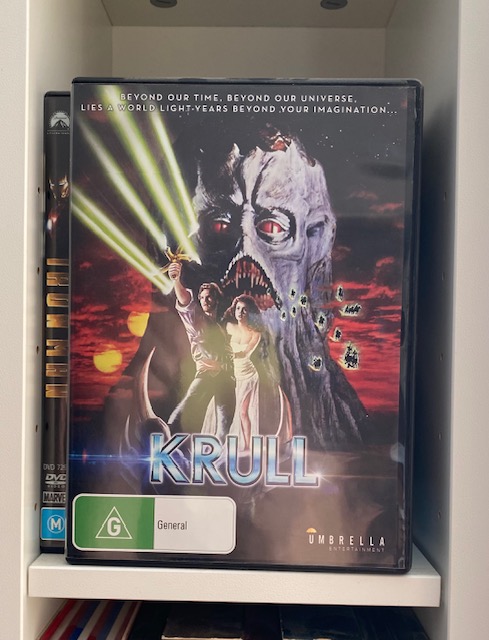
Colwyn and Lyssa are the heirs to their respective kingdoms. They’ve come up with a plan to unite them in the face of a mysterious enemy called the Beast. The Beast has a travelling castle and has been terrorising the world of Krull. Colwyn and Lyssa’s plan is pretty simple: they’re going to get married, uniting their two kingdoms under one banner. However, on the day of the wedding, a small army of creatures called Slayers attack their party, murdering nearly everyone (except for Colwyn) and abducting Lyssa. Colwyn is nursed back to health by a mystical wizard named Ynyr and told that the Beast can only be defeated by a singular hero wielding a singular weapon, known as the Glaive…
(I will get the obvious moan out of the way here: there is already a weapon known as a Glaive, and it looks nothing like the throwing star wielded by Colwyn in this film. It seems to be the most obvious and tedious complaint that everyone levels against Krull, but it’s probably the least of the problems facing it)
Krull (1983) is a film directed by Peter Yates (1929 – 2011), who is probably most famous for his work on Summer Holiday (1963) and Bullitt (1968). It was written by Stanford Sherman (possibly best known for Ice Pirates (1984) and Any Which Way You Can (1984)), from an idea by Columbia Pictures president Frank Price.
The idea, apparently, was “Do you want to make a film about Dungeons And Dragons?”
(To be perfectly fair, you can buy a glaive in Dungeons And Dragons, but it’s listed as a “Pole Arm” which is possibly where the confusion began. It’s the one on the far left in the illustration below, taken from my 1981 edition of the D&D Basic Rules.)

The initial draft of the script was commissioned in 1980. Yates was commissioned as director in 1981 and production began in 1982 with 23 sets across ten soundstages at Pinewood Studios, as well as planned location shoots across Europe… all based around a second version of the script which was later abandoned for Sherman’s original script, which was adapted as production continued. Filming began in January 1983, and it was released in the US in July of that year, and in the UK in December.
The initial budget was $30 million, quite high for 1983 (Star Wars: Return Of The Jedi, released in the same year, had a budget of about $10 million more).
Production was tricky, but not laboriously so, although Yates did take a three-week holiday during the shoot as he apparently disliked working on the movie a lot.
The reception to the film was muted, with it failing to recoup its production costs. Critics were fairly unkind at the time, calling it derivative and slow, though many praised Yates’s direction and the overall look of the film, largely the work of Stephen Grimes and Derek Meddings.
The acting is a mixed bag, however. Ken Marshall as Colwyn gives an ok performance, bringing a solid look to his character and working hard to extract as much meaning as he can from a fairly ordinary script. Unfortunately, he appears to be styled as a leading man from the 1940s, with the associated hair and enunciation of that era, making his performance seem rather stilted compared to the more naturalistic performances around him. The other royals around him at the start of the film, however, also appear to be from a similar mould, so it’s possibly the fault of the movie for not giving us more time with them to establish these differences between them and the common men who aid Colwyn later. It’s harder to judge the work of Lysette Anthony (Lyssa) since her voice was dubbed over by Lindsay Crouse (for more “vocal maturity”, apparently), but I’ve seen her being great in several other movies and shows, so I don’t doubt her original performance was pretty solid. Like Marshall, she appears to be made up as though she is from an earlier era as well, although her hairstyle is authentically 1980s in construction.
They are joined by Freddie Jones as Ynir (interestingly, Jones originated the role of “Sir” in the Ronald Harwood play The Dresser, which was Yates’s next directorial gig after Krull); Francesca Annis as the Widow Of The Web; and assorted actors who join Colwyn in his quest, a list that includes Alun Armstrong, Liam Neeson, Bernard Bresslaw and Robbie Coltrane (dubbed by Michael Elphick).
I’m going to go out on a limb and say that there’s a lot to like about Krull. In my not-so-humble opinion, a lot of the issues with it do stem from the rather disorganised production of it, but the biggest problem lies not with the movie but with the genre, which in the early 1980s was having a bit of a moment.
The plot is pretty simple: an enemy threatens the realm, and the hero must assemble a team and collect some plot coupons to defeat them, hopefully rescuing his love interest along the way. So far, so Clash Of The Titans and Beastmaster. But the real key to his success is a weapon that only he can use (a nice nod to Excalibur). Along the way, the heroes must deal with enemies and adventures that play little to no role in the actual story (a la Conan The Barbarian but, alas, more like Spacehunter: Adventures In The Forbidden Zone), save that they cost them members of their band, including the wisest one of all (thank you Star Wars, only recently subtitled A New Hope, and The Lord Of The Rings) The final battle takes place in a grim citadel populated by monstrous creatures living in bizarre architecture (as per The Dark Crystal).
It is also important to point out that Krull was in production while a lot of these films were being made, so it is entirely possible that any similarities can be blamed on the limitations of cinematic fantasy rather than any conscious or unconscious attempts at ripping off/homage.
But where Krull differs from a lot of these is in the way it uses them.
The world of Krull is very clearly styled on some kind of High/Epic Fantasy model. We have armoured men on horses, castles, peasants, sword fights, fell beasts (the stop-motion spider is wonderful!), wizards… however, the Beast and its entourage come from space, using science-fictional weapons against traditional fantasy ones. This is quite a novel idea, and it adds to the eerie otherworldliness of the Beast and its Slayers, although the opening shot of the movie, with its never-ending sequence of the Beast’s ship/citadel traveling through space does evoke memories of Star Wars which had a similar but far superior moment in its introduction.
However, the SF-nal nature of the foe is a great idea, and it adds an extra level of desperation to the struggle of our heroes.
And, courtesy of the extensive location work, we get a lovely look at the world Colwyn and Lyssa are fighting for. There’s a ridiculously high amount of exterior filming in this movie – far more than you might normally expect to see in a genre film of this calibre – but it adds immensely to the epic feel of the story. It’s just a shame that it’s so sparsely populated. In fact, if it weren’t for a scene involving some peasants who aid our heroes – including a changeling sent by the Beast to tempt Colwyn – you might believe that Krull is populated entirely by the nobility. This “unlived in” feel to the world is part of what makes the film a failure: it doesn’t have that patina of everyday usage and grime that added to the verisimilitude of Star Wars, or which made the backgrounds of films like Richard Lester’s Three and Four Musketeers a decade earlier so effective.
But we do get the sense of a wider world through the supporting characters, particularly Torquil (the leader of the bandits), Ergo (a magician who never quite gets his spells exactly right), and Rell (a Cyclops with a bitter secret).
Torquil (Alun Armstrong) feels like he’s in a different movie to Colwyn: whereas Marshall’s idealism and stubborn heroism carries the first part of the movie, Armstrong’s jaded but loyal bandit straight away feels like a character with layers beyond the normal. A lot of that is the fact that he’s played by an actor with a feel for the hard-knock life (Armstrong originated the role of Thenardier in the West End production of Les Miserables), but part of it is that because he agrees with Colwyn in a lot of things but just doesn’t quite trust him as a member of the nobility.
Ergo (David Battley) is a magician who is very sensitive about his height and his talent. His spells of transformation (read from the loose pages of a book that you think he might have stolen from a more competent magic-user) never quite work, transforming himself rather than his erstwhile opponents. Very obviously the comic relief in a film that desperately needs it, Ergo nonetheless undergoes a terrific character arc where he learns to care about the people around him, particularly Titch, a boy who travels with the group, and Rell the grim but lonely Cyclops. And his personal discovery in the climax of the film that he can use his misaimed talent usefully, is a character theme that I love.
Rell’s journey is one of the things that really lifts the film for me. His people made a deal with the Beast many years before (begging the question of just how long the Beast has been hanging around on Krull) and bargained away one of their eyes for the ability to see the future. The Beast cheated and gave them the ability to see only one thing: the moment of their death). Rell follows Colwyn’s band around for a large chunk of the movie, making us wonder if he’s friend or foe, but when he makes his intentions clear, he becomes a firm favourite (at least of this viewer). His friendship with Ergo and Titch is quite touching, and the moment that he leaves the group, knowing that it is his time, is quite subtly and movingly played. The twist to this scene – that any attempt to avoid the foretold death will result in a much more horrifying end – is played beautifully, although quite predictably as well. Rell (Bernard Bresslaw) is a great character, although one does wonder how he is such a great shot with his spear when he lacks the depth of field to throw with any kind of accuracy.
Finally, though, I want to talk about Colwyn and Lyssa. Marshall and Anthony frequently appear to be in a different film to that of their colleagues, but their romance – born of mutual attraction propped up by political expediency – feels quite genuine. Their relationship in the eyes of the viewer isn’t helped by the fact that they are separated for most of the movie, but they give the early scenes a earnestness and familiarity telling us that this is a couple who want to be together.
Anthony’s performance isn’t helped by the overdubbing in postproduction, but the real problem arises from the fact that, after the beginning, she has several scenes where she has to act against a set or a (frankly terrible) model/effects shot of the Beast. Originally conceived as a dragon, the Beast becomes a vaguely humanoid creature that seeks to seduce Lyssa into marrying it, largely because of a prophecy that her child will rule the galaxy (and it doesn’t help that this part of the movie utilises an idea that would be done better the following year in Legend and two years after that in Labyrinth).
However, if you’ve ever had to act without the support of other actors, relying only on what you know about the setting and your situation, it isn’t hard to find your sympathies lie with Lysette more than Lyssa.
What elevates their performances, though, is the idea that Colwyn and Lyssa are working together throughout the film. Their first scenes show that they respect the skills and resources that each of them are bringing to the marriage. This is doubled down on in the climax, when their only chance of defeating the Beast is to work together again. This sense of two equals in the romantic and dramatic stakes isn’t something that we see very often in this genre of movie at this point in history, so it’s worth celebrating here. For all that the film tries to paint Lyssa as a damsel in distress, she refuses to succumb to that easier option.
Unfortunately, I’m going to ruin that climax that I’ve just built up by saying that it is the worst conceived and executed scene in an otherwise competently produced film. The scenes of Colwyn and Lyssa have very obviously been shot on different film stocks to those of the Beast, and it doesn’t help that we very rarely see more than part of the Beast’s body. This was a technique used in Alien (1979) but where the titular monster in that film was never fully shown until we approached the end of it for dramatic reasons, the Beast here is just a victim of poor design and conflicting production goals. It really does take you out of what could have been a moderately gripping finale, though, and it does do a disservice to the rest of the film that has gone before it.
But it’s still a better film than its reputation would have you believe.
For me, at least, anyway.
I first saw it on home video, a year or two after it was released. While I wasn’t blind to its faults, the fact that there was a film that managed to capture (or at least mildly inconvenience) nearly all the ideas about a fantasy story that I loved in one place made up for its deficiencies.
Let’s put this into some perspective…
In the early 1980s we didn’t have the huge range of genre programming available to us that we do now. So, unless we had very low standards and a penchant for masochism, we had to get our genre kicks mostly from books, which was hardly a chore for me. Fortunately, there were many more books than there were movies, and they didn’t have budget or production issues to ruin your suspension of disbelief or investment of belief. I’ve also discussed several of them here before.
But Krull was the first movie I had seen in a long time that properly reminded me of those books. It had a large cast of characters, some half-decent fight scenes, some great effects (the creatures inside the Slayer’s armour slinking away below ground when defeated still stands up okay today), some cool ideas to lift it above the competition, and the acting from many of the players, as well as their character’s backstories, seemed to give it more heft than a lot of the competition. The themes of it – about heroism, loyalty, doing the right thing despite the odds – also matched up with the kinds of stories that I liked reading.
This was largely helped by the novelisation. Like so many films in the 70s and 80s, there was a book that was released around the same time as the film. And, like so many of them, it was written by Alan Dean Foster. He did a competent enough job on it (as he always did, to be honest), but for several years, it was the form of the movie that I interacted with the most. And he managed to elevate the bog-standard story into something that had some depth and gravitas, especially with the supporting characters who lived a little more on the page than they did on the screen.

I don’t have my copy of that novelisation any more, but I do have the memories of it which influences the way I watch the movie to this day. Its constant stream of incident and peril means a lot more to me because of that investment of clarity from the supporting material around it. It shouldn’t be so – the movie should really stand on its own – but it is always a joy to be able to look at a scene and be able to get some context and subtext from the performances and script that you might otherwise or not be given a chance to internalise. Which is another flaw that you can lay at the feet of the production team behind this movie, but let’s not go too deeply into that…
Honestly, like a lot of books and movies on this blog, Krull has been selected because I remember it fondly. I will be the first to admit that isn’t a very good film, but I watched it at a time when I was receptive towards a story of this type. Krull just happened to tick the boxes I needed ticking at that time for entertainment. And it is, in the main, an entertaining film. It’s largely the fault of a fractured production team that its flaws have been so amplified. But for a little more unity of purpose behind the camera, it would be more fondly remembered today.
You can find out more about Krull at: https://krull.fandom.com/wiki/Special:AllPages

 Stuff Ian Likes