After exploring some of the big issues of life in the last few books, Soul Music marked a bit of a return to the Pratchett of old, with loads of puns, slapstick and a menace from beyond-the-universe-we-know.
It’s the story of Imp y Celyn, bard. Having had an argument with his father on the nature of music, he has left his homeland of Llamedos (in a lovely nod to Dylan Thomas) with only his robe and his harp, and come to seek his fortune in Ankh-Morpork. He teams up with Lias Bluestone, a troll who plays tuned rocks, and the dwarf Glod Glodsson (hornplayer), and they start a band together.
However, it’s also the story of Susan Sto Helit, daughter of Mort and Ysabell (from Mort), granddaughter to Death. She’s currently at school, unnerving all her teachers and trying to make sense of her life as someone who appears to be more real than the world around her, with the bonus of also appearing as less significant or even noticeable at the same time.
And it’s the story of Death, who has left his post again, this time because he isn’t sure if he is really cut out for it after being forced to witness the deaths of Mort and Ysabell.
But there’s the return of the faculty of Unseen University, led by Archchancellor Ridcully. They have sensed the arrival of something new on the Disc and have reacted accordingly…
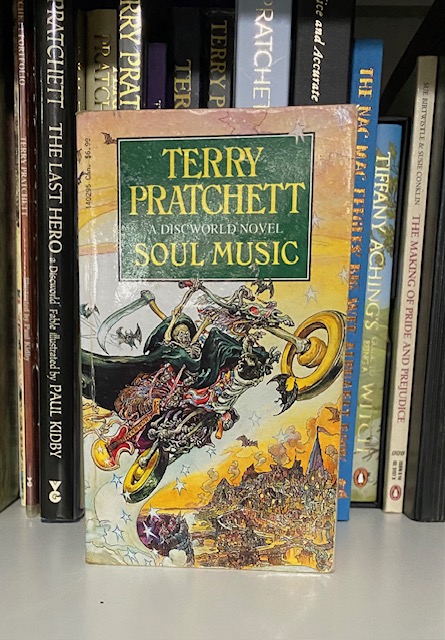
I’m going to be upfront and say that I think Soul Music has some of the best jokes in the entire series. The Discworld versions of band names are seemingly endless and never get old, and the tributes to movies about musicians, or even movies that have famous songs in them, never fails to amuse. There are some truly epic running gags that are a complete delight.
However, as a story, it is a bit pants.
I mean, the idea of sentient music (dubbed “Music with rocks in” by Lias) seeking a foothold into our universe and inflaming impressionable minds with the love of it isn’t bad, but it’s way too similar to the denizens of the Dungeon Dimensions trying to break through to the Disc’s universe in Equal Rites. The idea of a magical force seeking domination through an unwitting host was also done in Moving Pictures (and the overall effects are remarkably similar here, as well). And Death taking a break has happened twice before, in Mort and Reaper Man. It doesn’t really matter that each of the reasons has been different, it’s still a bit repetitive (he will do it again in a few books time, but it will be for a much better purpose). Even when Susan intervenes in the event that was supposed to cause Imp’s death and saves him, creating another reality in which he becomes a major music star, she’s re-enacting a plot point taken directly from Mort.
So all this might have you thinking that I dislike this book.
Far, far from it.
This is a popcorn novel: it’s a perfect way to wile away a lazy afternoon or two. The story is captivating and Imp’s battle against the bureaucracy of the Music Guild (more on that in a moment) and against the power of the Music With Rocks In that wants to use him as a conduit is quite compelling as well.
It’s just all a bit familiar from other books, is all.
There is loads to enjoy aside from the plot. I mentioned the music jokes but there’s so much worldbuilding going on here and there’s a load of ideas that would be revisited later on that you can’t help but be intrigued by some of the possibilities.
As an example, there’s Susan’s two friends at her school, Gloria and Jade. Gloria is a dwarven girl who displays her femininity for all to see. This makes her different from the dwarfs we have met so far, very few of which have been female (apart from the unseen Minty in Guards! Guards!). Gloria ties ribbons in her beard in the school colours, which makes for a lovely sight gag, however, she is also different from nearly all the dwarfs we meet in the later books in that she has declared herself to be female and is showing it. Now, Pratchett borrowed this idea from Tolkien’s dwarfs, in that it was very hard to tell male from female in Middle-earth as well. In later Discworld books, though, all dwarfs are assumed to be male, with the very idea of femaleness being almost a horror to them. Gloria, though, is attending a human school, so some concessions must probably be expected to be made.
Susan’s other friend is the troll, Jade. Jade’s father is a troll king, so there’s a certain amount of prestige in having her as a student at the school. One of the important things about her, though, is her name: you see, in a much later book there’s another troll named Jade (although we don’t learn this until quite a way into the story), and my head canon is that she is the same character, having left school and seeking her own way in the world.
Susan’s friends are important because they mirror Glod and Lias, with Imp mirroring Susan. Imp, although his name means something else, suggests an otherworldly creature, despite him being quite ordinary. Susan is a partly otherworldly person but tries desperately hard to appear quite ordinary. This suggestion that they may be linked in some way is frequently alluded to as well and it’s hinted that it may continue into the future in the conclusion of the story.
Another aspect of the story that I love is the fleshing out of the guilds, particularly the Musician’s Guild and their secretary, Mr Clete.
But first, let’s delve back into Ankh-Morpork’s history a little…
… When the current Patrician, Lord Vetinari, came to power, he changed very little about how the city was run. One thing he did do, though, was make the guilds official. This might not seem like much, but he recognised the authority of the Thieves Guild, the Assassin’s Guild, the Beggar’s Guild and so on as being equal to that of, say the Merchant’s Guild or the various craft guilds. They were allowed to exercise power in their fields and monopolise them. What this did, and what Vetinari planned, was that it would encourage them to clean up their houses and become almost law-abiding. It also meant that he had access to their lists of memberships in case any of them stepped out of line…
However, it reduced the amount of unlicensed crime in ankh-Morpork and allowed Vetinari to concentrate on what he really wanted: to accumulate power for the city across the region and, thence, the world.
The Musicians Guild controls all music being played in Ankh-Morpork: you cannot perform in a concert hall, pub or street corner without being a guild member. However, you can’t become a guild member without being able to perform (This mirrored a real-life situation with Actors Guilds in many of our own Roundworld countries, in that you can’t get employed as an actor without being a member of some form of union, but not being able to become a member until you have a job as an actor).
Imp, Lias and Glod become performers without Guild membership. They get taken under the wing of C.M.O.T. Dibbler, who has an almost psychic gift for spotting a chance to make money, and embark on a whirlwind tour of the cities near to Ankh-Morpork, and they set off with the Guild – and Mr Clete – in pursuit (and if you’ve seen The Blues Brothers or heard Don McLean’s American Pie or Meatloaf’s Bat Out Of Hell, the cover of which is beautifully parodied by Josh Kirby on my edition, you might have an inkling of how that tour turns out for them and others).

This was an astonishingly popular book when it was first published and it strengthened Pratchett’s reputation, newly refreshed after the release of Small Gods. It was successful in another way, too, in that it was one of the first Discworld novels to be adapted for the small screen by Cosgrove-Hall Productions who had successfully adapted Pratchett’s earlier children’s novel, Truckers a few years earlier. It was paired with Wyrd Sisters as a chance to show the variety of stories that could be told on the Disc. Like most future adaptations, it met with middling success, despite being made with a tremendous amount of enthusiasm by the company. It captures the tone of the book quite nicely, but it just lacks that “something” that makes it a truly brilliant adaptation. It is fun to watch, though, if you want to seek it out, and the soundtrack is a lot of fun.
For myself, it is a beloved book simply because of just how easy it is to read and be swept away by a fun story. There’s the rather touching story of Susan and Death reconciling themselves to being family. I was also struck by just how well Pratchett gets the mystique of Music With Rocks In for the ordinary person. Pratchett grew up with Rock and Roll and had an eye for what similarities the lives of a lot of stars had. Most of those beats are covered here, in rather more detail than they were in Moving Pictures, but with a better grasp of the potential tragedies that sudden fame can bring to an otherwise normal person.
Coming Up Next: Rincewind goes straight from a mundane and quiet life to finding himself living in Interesting Times.

 Stuff Ian Likes
7 thoughts on “The Great Discworld Retrospective No. 16: Soul Music”