The oldest – and possibly least useful – piece of writing advice is to write what you know about. Most authors of Speculative Fiction (that’s Science Fiction and Fantasy under one roof) have chosen to ignore that and taken on a whole shelf of arcane and niche knowledge in order to cultivate their readership.
By 1998, when The Last Continent was published, Terry Pratchett was a frequent visitor to Australia. He first came out in 1990, publicising Good Omens (I missed the Hobart leg of that tour due to me having a class: my mother offered to go stand in line for me and pick up a signed copy as a Christmas present, but I declined, knowing that she had work that morning as well. In hindsight, a signed first edition of Good Omens would have been a lovely retirement – I mean – Christmas gift). He made regular trips after that, most of which seemed to be research for this, the 22nd Discworld novel.
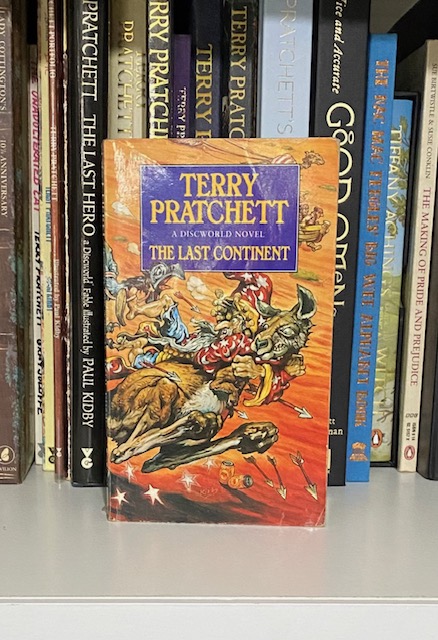
We see the return of Rincewind, as well as the Faculty of Unseen University. Here we get Rincewind some time after the events of Interesting Times, travelling through the deserts of Fourecks and encountering many characters, but mostly being protected by a guardian angel in the form of a kangaroo named Scrappy (Scooby-Doo comparisons are possibly welcome here, too). I don’t want to, um, Skip over his many adventures, but suffice to say that Rincewind does encounter loads of other characters (including a Dwarf named Max who is certainly not Happy), that you might recognise from a certain Roundworld country that bears superficial similarities to Fourecks. He also spends a lot of time trying to escape from his destiny, which is to bring rain to Fourecks.
Meanwhile, the Wizards are searching for Rincewind (again) because he might provide the only cluse to help the Librarian who is suffering from a mysterious magical malaise that is continually transforming him into different objects. Their quest leads them an island belonging to a mysterious inventor, who nearly convinces Ponder Stibbons, the wizard who does most of the actual administrative work at the University, into staying with him and doing some real magical research and creation.
What follows is a madcap caper that culminates in Rincewind managing to make it rain and the Wizards curing the Librarian. It’s fast and hectic but doesn’t quite reach the heights that we saw in previous novels. It’s probably no coincidence that the last novel to be a tad disappointing like this was Interesting Times, also a Rincewind novel. That was the last novel Pratchett wrote as an explicit travelogue of humour centred around a particular country as well. Again, it’s probably no coincidence that – however well-intentioned and positive his intentions – Pratchett never really took such a wholesale approach to other cultures in his novels again, either. Rincewind himself will make one more appearance (as part of an ensemble cast this time) but won’t turn up again until 2009’s Unseen Academicals, and only as a minor character in that book.
In all fairness there is a lot to enjoy in The Last Continent; it’s just that it is really just a collection of cultural references in search of a plot. Being Australian, I found most of them delightful, but even in 1999, when I first read the paperback edition, I knew that his portrayal of Aboriginal Australians was problematic. They don’t appear much in the book, but they do occupy the spaces that Rincewind spends a lot of time in, as well as providing a lot of the inspiration for the particular style of magic being used in the book. And, unfortunately, the way Aboriginals are portrayed does smack of cultural appropriation and tokenism: they mostly observe Rincewind and his exploits without taking much part in them other than making wry observations about his general incompetence. It’s really patronising, even when you can see that Pratchett was making a genuine effort to be a respectful ally.

But for its day – because I refuse to judge an obvious effort at cultural sensitivity by the standards of twenty-five years later – this was a decent portrayal. I mean, at least none of those characters are trying to be Chakotay from Star Trek: Voyager, with his fictional and fraudulent Native American heritage.
But this was not at the forefront of my mind when I first read it. My family and I had moved to the Pilbara region of Western Australia a few months before this was released in paperback. Given that there was a distinct lack of bookshops in that region, I was thankful that I was able to order this in. I took it away with me for a professional learning session after it arrived – this involved me travelling two hundred kilometres to meet a colleague who was also attending, then both of us travelling a further 250 kilometres to get to the venue. This travelling was done after I’d finished for the school day as well, so I was a little bit tired when I finally arrived – and, of course, two days later I had to make the journey in reverse.
Being a recent arrival in the region – and the state – I knew nobody at this gathering, so I was pleased that I had the latest Discworld novel to keep me company in my downtime. I was also thrilled that it was set largely in a location that was not dissimilar to where I lived – or at least, a half-hour walk in any direction from where I lived. As I’ve said elsewhere on this blog, I did not have a tremendously successful time in the Pilbara (finding the region referenced in an H. P. Lovecraft story some time later was a sniggery pleasure), so any kind of reminder that there was a world outside that I might be able to get to someday was a blessing. The sensation of déjà vu I got from Rincewind also being in a situation that he hated and couldn’t control was not lost on me, either.
But while it was lovely to read about – sort of! – the part of the world I was living in at the time, it was even more lovely, about fifteen years later, to be almost personally referenced in a brief journal of a recent tour during which, I am sure, this novel was percolating if not being written. The reference is from his non-fiction collection, A Slip Of The Keyboard, and it goes like this:
Day 11
Fly to Purdeigh Island
Noon: Busy signing at general bookshop; foreign authors don’t often come her, so everyone’s got everything.
And down the length of the island to:
Evening talk/signing organised by local bookshop in the Country Comfort Hotel. What a lovely name for a hotel.
When I managed to get a hold of The Compleat Discworld Atlas many years after that I found that in Fourecks, the equivalent of my home island was significantly larger than the real version, which was lovely – much less chance of it being left off maps as had happened to the real one several times. So it was great to have confirmed that his trip to The Country Comfort (as it is still known) was something that he enjoyed. Because I had a great time there, too.

Terry autographed my copy of The Colour Of Magic for me, which was great… however, when he asked for my name and I told him, he paused and said, “I’ve already signed something for you this tour, haven’t I?” And then, just a second or two later, he shook his head and said, “No – I’ve got you mixed up with someone else.”

I thought nothing of it at the time, but I was reminded of it a year or so later when I was engaged in best man duties at the wedding of two of my best friends and was presented with an MDF briefcase with Josh Kirby illustrations decoupaged all over it and a personalised inscription from Pratchett in the middle of it.

I know that this might be a reach, but the possibility that Terry remembered that he might ruin a surprise if he let on what he had signed raised him even further in my estimation, to be frank. I’ve also got several other autographed books from Pratchett but none of them hold as much pleasure to me as those two – and, yes, I have to say that it does make up for missing out on Good Omens.
Which is why, for all of its faults, I will always have a soft spot for The Last Continent.
Coming Up Next: Lancre has a vampire problem and Granny Weatherwax knows exactly how high the stakes are in Carpe Jugulum.

 Stuff Ian Likes