King Verence and Queen Magrat of Lancre have a daughter and are inviting the high and the mighty from all the neighbouring regions to celebrate her naming day with them. However, Granny Weatherwax’s invitation has been misplaced and she is under the illusion that she hasn’t been invited. Unfortunately, her absence means that some foolishly invited guests – invited under the aegis of Verence’s goodwill to all sentient creatures – make their entrance and begin an invasion of Lancre, one throat at a time…
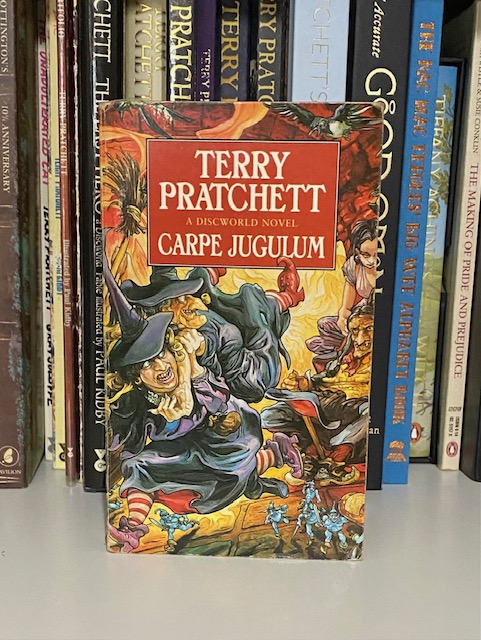
… It seems the Magpyr family are branching out from the more traditional vampire activities and are rebranding themselves as benevolent dictators: they just want a little blood and all of your freedom. And the invitation to the young princess’s naming ceremony gives them the perfect excuse to mingle with outsiders and really practice their new social skills.
Under those circumstances, it’s almost good luck for them that Granny’s invitation was misplaced because she is the only figure of authority who might conceivably quash the Magpyr’s plans…
… But Granny has disappeared… so it falls to Nanny Ogg, Magrat and Agnes Nitt to foil the vampire’s empire-building plans…
Carpe Jugulum sees the almost inevitable appearance of vampires on the Disc. I say inevitable not because there’s a sort of unwritten pop-cultural law that says “Any long-running fantasy series must use vampires,” but more because we’d already met Angua in Men At Arms a few books back so it seems only natural that a world which has werewolves must have vampires (to be fair we’d already met the Notfaroutoes in Reaper Man but they were more aspirational than actual vampires). So meeting the Magpyr family here was quite the experience.
To be perfectly frank, I don’t think that Pratchett was very impressed with the state of modern vampirism by the time he wrote this book. By the 1990s, the most famous of the current batch of literary vampires were Anne Rice’s “fang gang”: Lestat, Louis, Claudia, and everyone else from her Vampire Chronicles, spun off from her 1976 novel Interview With The Vampire. Her books presented vampires in a new light, as Byronic antiheroes rather than as bloodsucking parasites. She got away with it by having Louis admit to only eating the blood of rats and other small animals, and with Lestat seeking out people that society possibly wouldn’t miss too much.
I liked Rice’s novels for a while but I began to feel that she was taking the whole thing just a little too seriously by the fourth book, The Tale Of The Body Thief, with almost every aspect of mythology and current parapsychology being attributed to Vampires. But they were a lot of fun while they lasted, and I loved reading about the Talamasca, the quasi-secret society that lurks throughout so many of her books.
Naturally, the idea of a vampire as the hero of his own story was something that really caught on – Rice was merely the most literary and popular, rather than the first – and whole libraries of fiction sprayed out like a spurt of blood exploring the idea of the creatures of horror mythology merely having a bad press rather than being genuinely dangerous. Stephen King’s Salem’s Lot (published the year before Interview With The Vampire) seems remarkably quaint in the way it portrays the vampires as villains. And around the time that Carpe Jugulum was published (1998), there was a slew of vampires and vampire hunters in the public consciousness: urban fantasy as a genre was beginnng to really take off, marked by the success of Laurel Hamilton’s Anita Blake novels and Charlaine Harris’s Sookie Stackhouse series (later adapted as True Blood), while on television we were just beginning to be treated to Buffy The Vampire Slayer and its spin-off, Angel.
It seems, though, that Sir Terry wasn’t having it. He said in a 1995 interview that:
“…I dislike the cult of the modern vampire novel – I don’t really care if vampires are agonised, romantic heroes. Cut their heads off and fill the holes with garlic, that’s what you do with vampires! We’re talking about a species that views humanity as sort of walking cattle, as a load of potential empties.”
This apparent annoyance seems to have been spent by the end of this novel, though, because we get other vampires in future books who are non-consumers of blood, although in a properly unique Discworld manner.
Like traditional vampires in most novels, the Magpyr’s are really just stand-ins for something else in this novel. Their need for control and their desire to show themselves as perfectly normal and respectable resonates even more now than it did in the late 90s when Carpe Jugulum was first published, because we see all sorts of public figures who desire to be seen as someone normal and regular, right down to the scripted displays of mass affection that they show Agnes while trying to seduce her to their side. She reflects on how they appear to care their subjects without really understand anything properly affectionate or emotional towards them, while their subjects fully understand that if they resist in any way, the supposedly easy relationship will remain, but they won’t. This faux bonhomie is recognisable to anyone who has seen a politician of the last twenty years or so try to appeal to their electorate through references to popular culture and supposedly shared “struggles.” But at least we get the opportunity to vote our Magpyrs out: the inhabitants of the villages subservient to the vampires have no such prospects.
But Sir Terry was not the first person to make that connection, as no less a personage than Voltaire himself wrote,
“We never heard a word of vampires in London, nor even at Paris. I confess that in both these cities there were stock-jobbers, brokers, and men of business, who sucked the blood of the people in broad daylight; but they were not dead, though corrupted.”
However, there’s not just vampires in this novel: we are also introduced to the Nac Mac Feegle, tiny blue fairies who got thrown out of Fairyland for bad behaviour. They are modelled after traditional pixies (or Pictsies as they are referred to on occasion) but the reader may be forgiven for believing that they bear a more than passing resemblance to Smurfs, except for the whole fighting, drinking and swearing part of their lives. They play a small but vital part in the plot but this first appearance was so successful that they later appeared in another book which headlined them as major characters alongside another witch.
And Carpe Jugulum is also the last time that “our” witches – Granny, Nanny and Magrat – will play a major part in the books. They will continue to make appearances and contribute to plots but only as supporting or guest characters.
More on that when we get to it, though.
I didn’t enjoy this book very much when it came out. I felt that there were a lot of moments where I thought the usually-hidden machinery of the plot was showing a little and there seemed to be a lot of mention made of Granny’s abilities and powers. Certainly, she takes more than her usual amount of abuse and pain from her foes but she comes back even stronger and in ways that make her an almost unbelievably overpowered protagonist, which is in no ways entertaining.
But I did like Sir Terry’s view on vampires and what they might represent to a modern age. For a long time, vampires were a symbol of sexual potency and subversion. Here, we get that flipped, with the Magpyr’s actively courting humans to exploit them and finding ways of overcoming the traditional weaknesses of their kind. There’s also a fabulous running gag featuring various vampires and their attempts at fitting in by adopting a more conventional mode of dress and changing their names to something more acceptable.

This diluted appearance of evil – I hesitate to call it banality – is mostly played for laughs, but occasionally some real anger at what the vampires are doing to country around seeps through. There had been some glimpses of rage from Pratchett towards those who exploit other people and their situations for gain in past books – Interesting Times features some quite arch raging against the machinery of oppression – but it becomes explicit in the telling of this story that Pratchett believes that people deserve better in their lives than what they might currently have. It will be interesting to see where that belief goes in future entries in the series.
Coming Up Next: Vimes takes a trip to Uberwald and uncovers a cherry orchardful of intrigue in The Fifth Elephant.

 Stuff Ian Likes
2 thoughts on “The Great Discworld Retrospective No. 23: Carpe Jugulum”