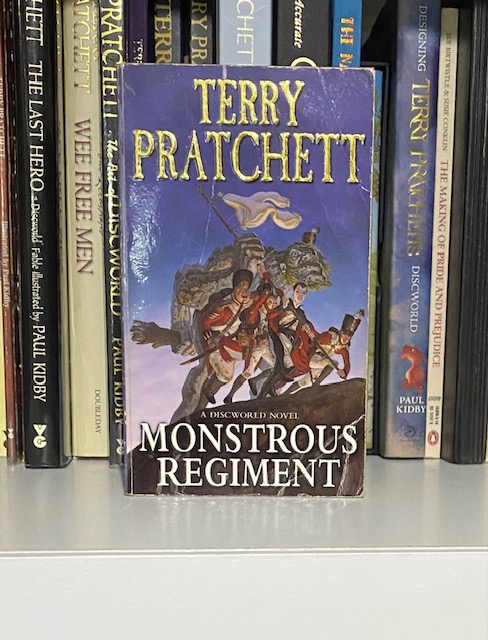
Polly Perks cuts her hair and joins the army: she wants to find her brother Paul who joined a year ago but who hasn’t been heard from for months. However, the war has been getting closer and her basic training becomes on-the-job as she and the other new recruits discover that they are just about the only soldiers still fighting…
Women and girls disguising themselves as men and going off to fight in wars isn’t just old in fiction, it’s as old as war itself. The Ancient Egyptian pharaoh Hatshepsut dressed as a man to legitimise her claim to the throne until her son was old enough to take it; there are some reports from the Crusades of women being discovered in men’s armour when bodies were being cleared off battlefields; Mary Read, the 17th Century pirate, disguised herself as a man in order to cut a swath across the West Indies; Hannah Snell assumed the identity of her brother-in-law and fought as a Royal Marine for several years in the 18th Century; Maud Butler, an Australian girl, was so moved at the sacrifices of her male peers on the outbreak of World War 1 that she dressed as a young man and tried to enlist as a soldier to go and fight.
So it’s no surprise that female characters in fiction have been doing it for as long as we’ve written down stories as well: Terry Pratchett’s Monstrous Regiment is just one story in a very long line of tales about this form of distaff deception.
As befits the soft reboot of the Discworld storytelling technique begun in The Truth, we are told this story by another newcomer to the Disc, one Polly Perks. However, Polly’s story is different to the that of William de Worde in that we are also being dumped into a part of Discworld that we have barely explored before: the duchy of Borogravia.
Borogravia is engaged in another border dispute with the neighbouring kingdom of Zlobenia. The two countries have argued over their border since time immemorial so another one is no different. However, this time things are going badly for the Borogravians: their ruler, Duchess Annagovia, hasn’t been seen in ages and their God, the niggardly Nuggan (first spotted as a background detail in The Last Hero) has been posting a list of Abominations that has made life very difficult for his worshippers as they try to follow his decrees. This has led to Borogravia becoming ridiculously poor, financially, and in terms of working bodies to fight and tend the fields and other industries. To not put too fine a point on it, Borogravia is losing.
This is driven home for Polly as she travels through the countryside as a raw recruit. Led by the nasty Corporal Strappi and Jackrum, the most resourceful Sergeant in any army, Polly and the other members of her band of… siblings discover that they are the last soldiers in the country: everyone else is either fighting, dead, or a prisoner. And I said “siblings” there: it’s not really a spoiler to say that all the other recruits around Polly are also girls on some quest or another. Or that each of them have been affected in ways that would break other people who didn’t have some sort of goal to drive them on.
This is probably the most successful of those books that introduce a brand new character. I said way back in The Truth that having new characters tell these stories was a way of keeping things fresh for Pratchett, as it revitalised the way he told a story. In Monstrous Regiment, the only other significant perspective we get apart from Polly’s is that of His Grace, Commander Samuel Vimes, who has been pulled into ambassadorial duties again, because the city-state of Ankh-Morpork, of which he is the duke of a significant amount, has invested a lot of money in the Clacks system (a cross between a semaphore and a telegraph) that is being torn down by insurgents. This means that information is not being relayed back to the city. This could cost them a lot of money. Vimes has therefore been despatched to deal with it. Unlike The Truth, Vimes exists largely as an expositional or framing device in this novel: he is there to have the story-so-far explained to him (and to us) and then to intervene when it becomes necessary. Also, unlike The Truth, I don’t really have an issue with how Vimes behaves here.
This expositional role that Vimes fulfills allows us to understand the situation from more than just Polly’s side. It also lets him fully convey the absolute horror of the war as it progresses – and not just to the combatants – and to get across his message that war is not just bad, it is mad and dangerous to be around.
Polly experiences this when she discovers that she and her cohort are not only going to receive less no training for this conflict, but that they are also going to be ill-equipped and unpaid as well.
But this sparks off a hugely resourceful and stubborn streak in Polly as she then discovers that there are other ways to fight battles. She rallies her troops, all of whom she discovers have strengths and burdens that they bring to their place in the world, and manages to resolve the conflict, if not satisfactorily, then in a manner that they can live in with some degree of pride.
Monstrous Regiment takes its title from the 16th Century pamphlet The First Blast of the Trumpet Against the Monstruous Regiment of Women by John Knox. It was written as a reaction to Scotland and England both being ruled by women. Knox argued that women ruling (a “gynarchy” was the term he used) was against everything in nature and religion (he also believed that women were an inferior reflection of God than men were). Pratchett’s use of the expression is a lovely pun that gives away several elements of the plot.
Knox intended to write a Second and Third Blast as follow-ups but the public reaction was so poor that he abandoned this project (and Britain as well, moving to Europe where he lived for several years afterward).
I have to point out that Knox was unsuccessful with this project not because the public were against him being a misogynist, but because Queen Elizabeth I thought his work was divisive. He apparently had cordial relations with the women in his life before and after writing this.
Plus ça change.

Monstrous Regiment was received positively by fans, especially because of the story. Polly and her troops were taken to heart by fans because they showed that you could be condemned by society but not ruined by it; that your worth counted for more than your gender and place in the world. Every character is changed by their experiences in the war. Every character has also been affected by their society and their religion. It’s well-known that Pratchett was an atheist. It was not well-known at the time, though, just how angry he was about the state of the world. The anger was usually kept below the surface of his novels, despite slipping out on occasion; however, since Night Watch, Sir Terry had been a little more confident at letting it out on “deserving” topics. Here he lets loose on nationalism:
“You take a bunch of people who don’t seem any different from you and me, but when you add them all together you get this sort of huge raving maniac with national borders and an anthem.”
sexism:
You get taken a lot more seriously if they think you’re male.
Blind obedience:
“What’s the good of me trying to teach you stuff if you’re going to keep on asking questions?”
and ignorance:
“Are you trying to be smart, Private Manickle?” Strappi demanded, naming the biggest sin in his personal list.
It’s important to note that Pratchett isn’t having a go at the military as a whole in this novel; just the ideas that lead to the military mind behaving as it does: unlike other authors, such as Harry Harrison, Pratchett doesn’t necessarily have an axe to grind with soldiers, just with the distance that their officers have from them.
I’d always liked Monstrous Regiment because of its story and the way it turned a ghastly situation into something that offered a glimmer of hope at the end, but it became even more special to me because it marked the second time that I worked on a play based on one of Sir Terry’s novels. In 2020 I was fortunate enough to be cast as Sergeant Jackrum in a local amateur production.
Jackrum is a huge part (in every sense). The sergeant teaches Polly a lot about what to do to get by in an organisation that expects ridiculous levels of obedience from its subjects, as well as how to deal with people who believe that they are your superiors (Jackrum refers to all officers as “Ruperts” believing that most of them have that sort of upper-class sock-puppety name). Jackrum is also the first to realise that Polly isn’t what she is saying she is.
But Polly is also the only one to realise what Jackrum’s own secret is…

I had a great time working on that show. The other cast and crew were amazing people to work with and I’ve since done two other productions with them (Hogfather and Guards! Guards!).
The adaptation is by Stephen Briggs and while I don’t believe he made a smooth adaptation from page to stage (we don’t find out what has happened to Paul, for one thing), it is one of his better works: he has smoothed out the plot so that it is more accessible to people who aren’t as familiar with the story, which was a big help for a lot of people I knew who came to see it.
But what he also did was take Sir Terry’s original story and make sure that it was there on stage: a lot of Discworld adaptations fail because Pratchett’s inner voice isn’t telling the story. Most of the humour in the Discworld novels comes from Sir Terry’s telling of it rather than from the situations or the characters. Many adaptations miss that point which just makes them feel quirky and mannered rather than the hilarious and pointed satires that they are.
Because of the serious themes of Monstrous Regiment, it was important that this content appeared on stage. Briggs understood this assignment and worked accordingly.
But none of this would be important if the original novel wasn’t any good. It’s a funny book, as are all the Discworld novels, but it talks about serious topics and explores the themes it sets out to explore and it steadfastly refuses to give any kind of ground to its opponent ideas. Even in a finale that threatens to fall into farce territory at any moment, it maintains a steady gaze at a society that expects more from its female members than it does from its male, while still subjecting that female half to a much greater scrutiny.
Coming Up Next: Tiffany is on her first assignment as a trainee witch and is up against a dangerous new foe: all she has to defend herself with are her wits, the Nac Mac Feegles and A Hat Full Of Sky…

 Stuff Ian Likes
One of my favorites
LikeLike
In a series full of favourites, I always love getting back to this one.
LikeLike